Taiping Heavenly Kingdom-Christian or Heresy: Europeans’ Understanding of God’s Religion

[Editor’s note]2021 is the 170th anniversary of the Taiping Heavenly Kingdom jintian uprising. The Paper Liu Chen, assistant professor of the Department of Private History and Peking University History, invited scholars at home and abroad to write a series of manuscripts to introduce readers to the new direction and achievements of the research on Taishi, hoping to help related research.

Through the efforts of predecessors, a large number of relevant materials have been excavated and published after the Taiping Heavenly Kingdom established Nanjing as its capital. Most of these historical materials are written by Jiangnan literati, and all of them describe Taiping Army as a "thief". Some of them are western-language materials recorded by missionaries after their visit to the Taiping Heavenly Kingdom, which mainly describes the activities of the Taiping Heavenly Kingdom after its March to Shanghai in the 1960s. This period has been the decline of the Taiping Heavenly Kingdom, and the discipline of the soldiers was lax. Most of the data described the Taiping Heavenly Kingdom, which was very different from that before the Tianjing Incident.

The materials introduced in this paper have never been noticeable in the past. In the 1950s, Europeans introduced and commented on the materials of the Taiping Heavenly Kingdom, which are currently collected by George Fornest Morrison; in oriental library, Japan. 1862-1920) library. These new historical materials mainly show the religious orientation of the Taiping Heavenly Kingdom, but also some scenes describing people’s life under the rule of the Taiping Heavenly Kingdom, especially some portraits worthy of attention.

Revolution in China: Causes of Revolution.

The first book to be introduced is The Chinese Revolution: The Causes Which Led to It. There is a portrait on the cover of the book, with the cross as a weapon (Figure 1), which reflects the expectations of Europeans for the Taiping Heavenly Kingdom at that time, hoping that it would be a Christian movement to civilize China. The book is strongly impressed by two illustrations, Rejoicing at Nanking after the Siege (Figures 2 and 3).
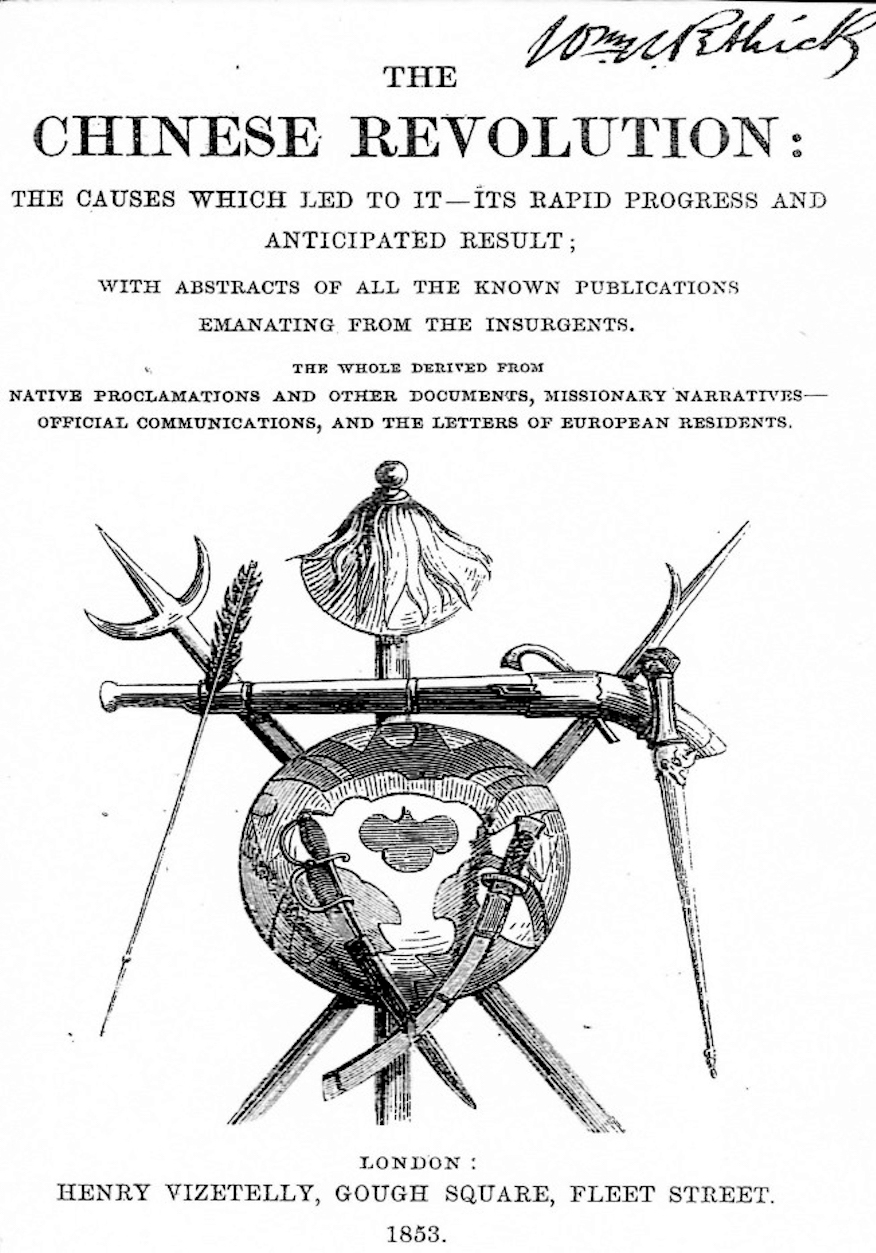
Figure 1 The cover of "Revolution in China: Causes of Revolution"
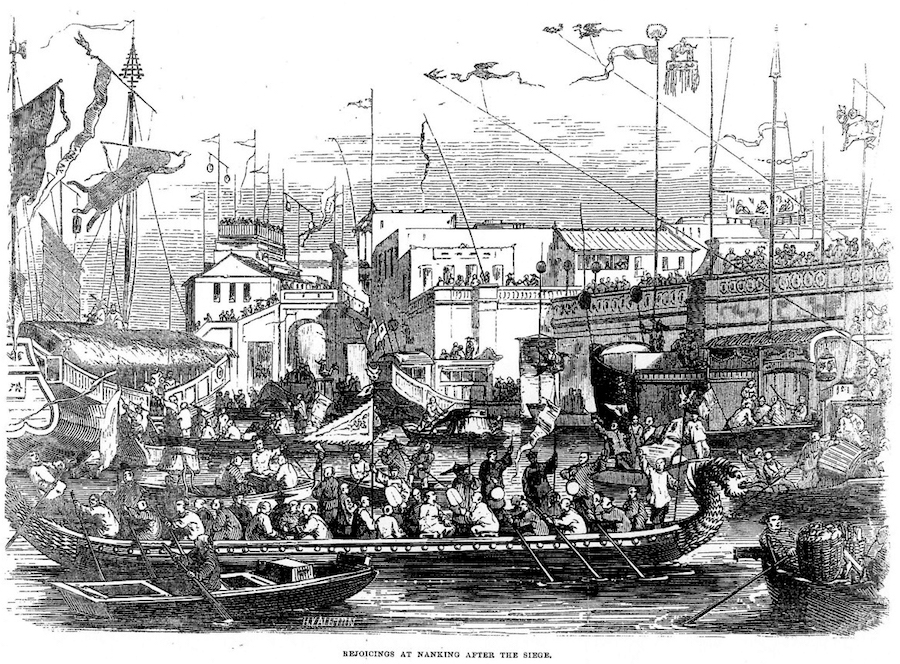
Fig. 2 One of Celebrating the Occupation of Nanking is contained in the anonymous Revolution in China: Causes of the Revolution.
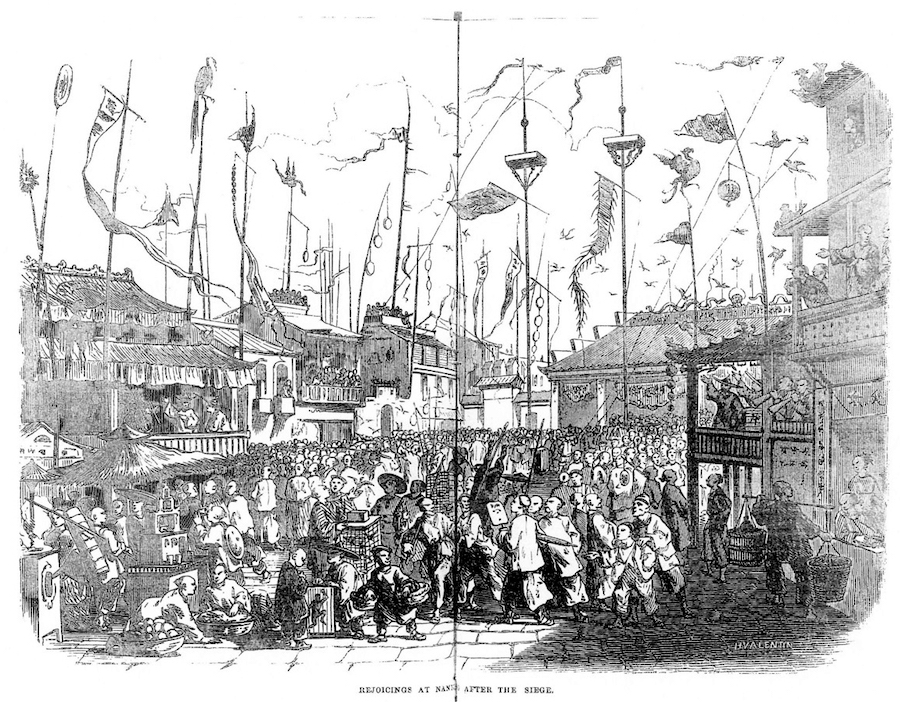
Fig. 3 Celebrating the Occupation of Nanking (Part II) is published in the anonymous Revolution in China: Causes of the Revolution.

The author of the book is unknown. From the preface, it can be seen that the author has not visited Nanjing. However, in the fifth chapter "Going to Nanjing", there is a detailed description of Nanjing by the British minister S.G.Bonham. It can be inferred that the author described the vibrant appearance of Nanjing at that time according to the minister’s report.

This book is notable for meeting with T.T.Meadows in Nanjing with Lieutenant Sprat, the British captain in Wei Changhui, the northern king. He described that the Taiping Army had a strong sense of mission, the Qing army was incompetent, the Taiping Army was supported by the people, and was keen to break the existing social order, especially the idolatry. Now he described it as follows:

They believe they have a mission from heaven to kill all the Mantchoos, and they certainly put this in execution as far as they can; and, without attempting to justify this practice, I believe that nothing short of driving the Tartars out of the country can make civilization progressive in China……

Confidence was said to be on the increase among the old population, and they were gradually returning to their homes, and I fully believe this to be the case, as we saw many carrying furniture and clothes, etc., into the city. We observed, also, that the houses of the better classes of Chinese were sealed up by the insurgent chiefs, I fancy to prevent their being plundered; not so those of the Mantchoos, which they evidently consider fair game─the disgorgement of unjust gain and plunder from them for other Chinese. Their clear principle is, China for Chinese.(p.127)

From this, it can be seen that the generals of the Taiping Heavenly Kingdom believe that it is a mission entrusted by God to destroy all Manchus. Although they didn’t use theory to justify this behavior, Sprat also thought that the Qing Dynasty should be expelled for the sake of China’s "civilization progress". In addition, the description that they saw that Nanjing’s population was gradually recovering and people were moving their belongings and clothes to the city gave a clear message that this was "China of Chinese", and it was unreasonable to blame those rich people whose mansions were occupied by the leaders of Taiping Army and their property was confiscated.

Secondly, Sprat pointed out that people in the Taiping Heavenly Kingdom have strict ethical norms, they try to separate men and women, and their courts are open to litigants, which is different from the practice of torture in the yamen of the Qing government. People call Taiping Army "Holy Army", Nanjing "Holy Capital" and "Brothers" to each other. Sprat also made the following comments on the incident of killing the flag bearer when the Taiping Heavenly Kingdom occupied Nanjing:

It is horrible to think that they cut off 20,000 Mantchoos, even to the infant at breast, but they seem hostile only to them; but it is still more horrible to think that the Mantchoos, in two of the many provinces, cut off as many in the name of justice within the year(we know of 2,000 in six weeks); and this in the name of justice! The former is the exception, the latter is the rule. It may prove the least sanguinary practice in the end. Like Cromwell’s severity at Drogheda, it has struck terror into their opponents; the Mantchoos are chapfallen and almost afraid to approach them; they say that six of them would beat any twenty imperialists; They talk of their strength, when we know a multitude of them are but boys, and or their red eyes, etc.

If they succeed,─and I fancy they will, and soon─they will deliver three hundred millions from the grossest of immoralities, the most grovelling of idolatries, and the most grinding of tyrannies. China will be opened to light, life and civilization, all which will be thrown with all their influences and importance into the Anglo-Saxon scale.(pp.128)

Sprat was really horrified at the massacre of more than 20,000 banners, including children, by the Taiping Army, but the targets of the massacre by the Taiping Army were limited to hostile people. He believes that the Taiping Army’s practices are different from those of the Qing Dynasty in the name of justice during this year. The massacre of Taiping Army was a case. On the contrary, the Qing Dynasty regarded the massacre as a means of rule, which was even more terrible. This is quite different from the view of E.G Fishbourne, who visited Nanjing at the same time. Fei did not believe that such an incident had happened, but Sprat’s view was actually relatively calm. Sprat also pointed out that after the Nanjing incident, the Manchu people were depressed and did not dare to confront the Taiping Army. On the contrary, even children in the Taiping Heavenly Kingdom were not afraid of the Qing Army at all. According to these facts, Sprat thinks that if the Taiping Heavenly Kingdom succeeds, 300 million people in China may be liberated from immoral, idolatrous and autocratic rule, and a civilization like that of Europeans will emerge, so he is full of expectations.

Wen Han, the British minister, and his party went to Zhenjiang after their visit to Nanjing, met with Luo Outline, exchanged some views, and discussed the prospect of Britain’s cooperation with or war with the Taiping Heavenly Kingdom in the future. This part of the content is basically the same as that described in Fei Shenbang’s book Impression of China. At that time, English historical materials often quoted each other, but from the time of publication, the content of this book can be considered to be relatively primitive. Chapters 5 and 9 of this book and The Doctrines of the Insurgents introduce the documents of the Taiping Heavenly Kingdom, Medhurst’s comments and the pastor’s letters published in the North China News, and also introduce Yang Xiuqing’s essays included in the Issuing Letters, recounting Yang Xiuqing’s proposition of expelling Manchus who were idolatrous and worshiping God.

From the foregoing curious documents, we are justified in inferring that there is evidently a tingle of fanaticism and of imposture in the religious cry raised by the insurgents, for, while they profess to venerate the religion of Jesus Christ, they do not scruple to style their own leader the younger brother of our load, who, they say, came down from heaven for the instruction of mankind in the Ting-yew year(1837), so that, although the foundation of their faith may be Christian, there is nothing to show that the superstructure is not as extravagant a superstition as Mormonism itself; and, as in the course of this narrative we have too frequently seen, they proselytize by massacre as much as by faith. Their belief in a special mission to destroy the Mantchoos—man, woman, and child , so that there may not be left a sprout for the race to reproduce itself—must certainly prove a bar to our perfect sympathy with them; and we are not surprised at the assiduity with which the English are recommending to their notice the New Testament in preference to the Old.(pp.166)

From this, the author believes that there are pains of fanaticism and fraud in the religious cry of the Taiping Heavenly Kingdom. Its foundation is Christianity. Although they are not as superstitious as Mormonism (a Christian sect that appeared in the United States in the 19th century), they use faith and cruelty to force others to convert. The Taiping Heavenly Kingdom took the mission of eliminating Manchu, and this belief became a stumbling block for Europeans to sympathize with them. It is understandable that the British advised them to attach importance to the New Testament and not to believe in the Old Testament. In other paragraphs, the book also compares the strong aggressiveness in the teachings of the Taiping Heavenly Kingdom with Islam and Mormons, and has doubts about the Taiping Heavenly Kingdom’s revenge on the flag bearer, polygamy (the lust of the leaders) and the desire for sovereignty.

Chapter 10 of this book "On the Political and Commercial Aspects of Revolution" predicts that after the continuous development of the Taiping Heavenly Kingdom, the demand for merchants to carry gold conveniently will continue to increase. Legalization of opium trade in Qing Dynasty will bring great influence to India and Britain (East India Company). It also pointed out that, unlike the progress of the revolution, the export volume of tea and inland commodities will decrease. In Chapter 11, "The Present Situation and Future of Guangdong and Beijing", the author has seen that under martial law, due to the influence of secret societies, Guangdong residents will appear anti-Qing movements. Rich people will take their property out to take refuge, Guangdong will be easily occupied, and once Beijing falls, Guangdong people will support the Taiping Heavenly Kingdom.

What is more interesting is the author’s account of Beijing. Unable to support the huge military expenditure, many banks have closed down one after another, and the price of rice has soared, which has dealt a great blow to the poor. Beijing’s grain has always relied on the transportation of the Grand Canal, and recently some maritime transportation has been opened. However, since the fall of Nanking, the Grand Canal can’t be transported, so we have stepped up planning to transport rice from Taiwan Province. However, it is doubtful how effective it is. The Qing government, which was in financial difficulties, confiscated the property of the defeated imperial envoys Sai Shang ‘a and Xu Guang ‘an, and executed some military generals. This was in fact a government suicide. Lu Jianying’s family, who was killed by the Taiping Army in Nanjing, was also severely punished, and the donation of rich nobles such as Mu Zhang ‘a and Jie Ying also aroused social resentment. It can be seen that Europeans at that time collected various information and paid attention to the success of the Taiping Heavenly Kingdom and its impact on the economy.

Revolution in China: Habits, Manners and Customs of China and Chinese.

The book to be introduced below is The Chinese Revolution, With Details of the Habits, Manners, and Customs of China and the Chinese, written by Charles Macfarlane. The author is famous all over the world with two books: Japan and the Life of Wellington. The main body of this book is divided into three chapters, which describes the process from the Qing Dynasty’s entry into the customs to the Taiping Heavenly Kingdom’s occupation of Nanjing. The appendix contains 10 kinds of historical materials related to the Taiping Heavenly Kingdom. What is striking is the relevant historical materials in Appendix 3, Religious belief, which lists seven categories of "Good points" and "errors" of God’s teaching.

In terms of "advantages", the first is their Belief in the One True God. The author points out that the teaching of God comes from the Old Testament Bible and the classics of China. According to the Taiping Heavenly Kingdom, ancient Chinese worshipped the true God. Before the birth of Christianity, Qin Shihuang began idolatry and gave up his belief in God. This statement is regarded as an example of China’s Origin of Western Learning, which holds that European ideas and cultures originated from Chinese civilization. However, the author did not criticize this argument as absurd, but evaluated it as their loyalty to the one true god. The second is "Adoption of the Decalogue of Moses". Regarding the fact that idolatry was strictly prohibited in the Taiping Heavenly Kingdom, he took the fifth rule "Be filial to parents" praised by most non-Christians as a teaching instruction, and compared with the indifferent attitude of the world not worshiping God, the father and the emperor, better explained the necessity of worshiping God. In addition, he also specifically described the fact that the Taiping Heavenly Kingdom prohibited adultery. On the seventh day, he advocated "it is not good to commit adultery" and "it is a crime to blow foreign cigarettes and sing evil songs". The third is the evaluation of their "Recognition of the Future State", thinking that they hold the concepts of heaven and hell.

Commentators list the "mistakes" of the Taiping Heavenly Kingdom: First, their understanding of Christian truth is incomplete. Second, they deny the "trinity" theory. As we all know, Hong Xiuquan later argued with missionaries about the "Trinity" theory. However, due to the lack of documents collected by Europeans at that time, even though the Taiping Heavenly Kingdom ignored the teaching of the New Testament, critics took a cautious attitude towards the criticism of the Taiping Heavenly Kingdom. In addition, the third and fourth "mistakes" of the Taiping Heavenly Kingdom were "Polygamy". Their comments are as follows:

I can not condemn them on account of these things so immediately and strongly as many do. Their obtaining among them, illustrates and confirms the view that they have not got the New Testament Scriptures, nor learned much from European or American missionaries. It is, believing this, that I cannot think very unfavourably or unhopefully of them, because of their offerings and their many wives. Should it turn out that they do those things, having the whole revealed will of God before them, and having had it enforced upon them in those very points by instructors, my opinion of them in those will be greatly modified. But at present, while from other grounds I infer their ignorance of our Christian records, there does not appear to me anything very culpable in the practices we are considering.(p.216)

It can be seen that the practice of polygamy by the leaders of the Taiping Heavenly Kingdom is the result of their failure to study the New Testament and the teachings of European and American missionaries. However, critics did not accuse the Taiping Heavenly Kingdom of polygamy or look at it with disappointment, but held a sympathetic mood. He thinks that since this is also the will of God, now they ignore the values of European Christianity, which has not caused much disappointment. As long as they improve their ethics, they will give up polygamy. Therefore, he thinks it is necessary to educate them fully and let them know the story about Adam and Eve in the second chapter of Genesis.

Polygamy of the leaders of the Taiping Heavenly Kingdom later became an important argument for European and American missionaries to accuse them of heresy, especially the fact that Hong Rengan, who lived in Hong Kong, had multiple wives was strongly criticized. Sprat also talked about this problem in his letter, saying that the Taiping King had 36 wives, but the general Taiping Army could not do so. They believe that this is the result of the lack of knowledge of the leaders of the Taiping Heavenly Kingdom. They only know the Old Testament and don’t know the New Testament. From this, it can be seen that for Europeans, polygamy has become their concern since they first came into contact with the Taiping Heavenly Kingdom.

Charles Macfarlane’s works also include important historical materials of missionaries’ understanding of the Taiping Heavenly Kingdom. One of them is a letter from J. Smith, bishop of the Victoria)J. Smith Hong Kong. His religious comments on the Taiping Heavenly Kingdom have many versions, similar to Mormons and Puritans, but their true image is unknown. In the information collected by Wen Han and his party, the religion of Taiping Heavenly Kingdom is a mixture of Christianity, superstition and China’s unique ideas, but the Bible translated by K. Karl Gützlaff can be seen everywhere in their tents. They are uncompromising iconoclasts and seem to have no communication with Catholicism. In addition, they call foreigners "foreign brothers" and have a friendly attitude. Except opium, they all intend to do business with foreigners. Wen Han and others predicted that the Taiping Heavenly Kingdom only took Nanjing as its temporary capital, and in the near future, they would attack Beijing.

According to this information, Smith made a positive evaluation, and thought that the Taiping rebels’ honesty to religion and patriotism of citizens could be seen from the leaders of the Taiping Heavenly Kingdom. Now China is facing great social changes, and the British Church should send outstanding talents from its own country to China to improve the level of Christianization in China. He also warned that Britain, as an empire with colonies, would eventually fall from the glorious throne if it failed to accomplish these missions and only pursued its own prosperity and wealth.

Regarding Smith’s evaluation of the Taiping Heavenly Kingdom, A.F. Lindley mentioned it in the History of the Taiping Heavenly Kingdom Revolution. However, the article "The Religion Character of Insurances" sent to the editor of China Mail by the missionaries in Guangdong at that time was quoted by the priest.

The Characteristics of Rebel Religion introduces in detail how Hong Xiuquan studied in Luo Xiaoquan after reading Good Advice to the World, and talks about the testimony of Hong Rengan after he fled to Hong Kong in 1852. Characteristics of Rebel Religion is similar to Luo Xiaoquan’s The Truth of Hong Xiuquan’s Revolution, but the author is not Luo Xiaoquan. The Characteristics of Rebel Religion also describes the rumor that Hong Rengan met T. Hamberg. However, the author is not Han Shanwen, but probably A.P.Happer who has done missionary, medical and educational work in Guangzhou.

The characteristic of the article "The Characteristics of Rebel Religion" is that although it talks about the persecution and suffering of worshipping God, it denies the armed uprising of the Taiping Heavenly Kingdom. The article holds that none of the Taiping Heavenly Kingdom’s doctrines and actions can satisfy people. What they did with the help of "the miracle hand of God" was a naked killing behavior full of hatred and fanaticism. Under the influence of the Old Testament, they destroyed idols and killed Buddhist monks, which was not so much what Jesus did as what Berial, the demon king of hell, did. The article also revealed the following killings initiated by the Taiping Heavenly Kingdom:

What has marked the whole course of this desolating scourge but plunder and exaction, bloodshed and murder─in many cases the most wanton and brutal murder of the peaceful and unresisting people, as well as of the officers and Tartars. The ears of the Canton people yet tingle at the mention of the wholesale and indiscriminate massacre of men, women, and children, at Tsiuen-chau city, in the north east corner of Kwang-si province. The number massacred at the capture of the three cities of Wu-chang, Han-yang, and Han-kau, will never be accurately known. Some letters state, that they themselves spoke, with the greatest coldness of feeling, of having massacred twenty-five thousand persons at the capture of Nankin.(p.132)

The author has mentioned in other papers that the massacre launched by the Taiping Heavenly Kingdom in Quanzhou, Guangxi in June 1852 described here is not a fact, but a fictional plot by people who were shocked by the uncompromising fighting image of the Taiping Army. However, from the historical data, we can know that this information has a great impact on people, and it has spread to all parts of Guangdong together with the news that the number of dead people in three towns in Wuhan is unknown and the number of dead people in Nanjing is as high as 25,000. The article holds that although the Bible forbids idolatry, it does not command them to destroy idols and temples by violent means, nor does it command them to kill monks and banners. The article also argues that missionaries in Shanghai should teach them well, and Christianity does not allow people to use weapons to resist persecution.

Charles Macfarlane pointed out that the two missionaries’ comments were too extreme, and in The Characteristics of Rebel Religion, they also agreed that the Taiping Heavenly Kingdom had a belief in the existence beyond the world. Confucianism has no feelings of faith, and people who converted to Buddhism can only worship idols if they are not satisfied in that cold philosophy. He thought that China needed a new religion at that time, and the Taiping Heavenly Kingdom was a movement initiated by people suffering from the cruel rule of the empire. Charles Macfarlane expressed the following views on the right and wrong of the Taiping Heavenly Kingdom using violent means:

As to the deduction of“conservative,”that these people cannot be Chriatians of any kind, because they wage war and shed blood, it is to be observed that Christianity never yet, immediately and on its first introduction, changed the whole character of a people. The English, the French, the Germans, the Spanish, the Italians, all engaged in wars after their conversion, and continued to carry on wars with ferocity and cruelty mane ages after Christianity had been preached to them, and their countries covered with Christian churches. One of the very first results of the Reformation was a long and bloody war, in which it can scarcely be said that the Protestants were much more gentle or merciful than the Romanist. The true Christian spirits was developed in Europe by very slow degrees; and how far we are, even at this days, from possessing it in fullness and purity, the last Annual Register , or the last newspapers, the records of a single week, or a glance at the actual condition of Europe(where the flames of war may be rekindled tomorrow), will give us sufficient proof and conviction.

We confess that we cling to the belief or hope that, however imperfectly, some seeds of the pure faith have been sown in China, and that great and happy results may be anticipated therefrom. At least this is clear, ─the Chinese have had awakening. Better almost anything than the dead sleep in which they have been lying for so many ages. Their condition, their vices, their government, their irreligion, were all so bad, that almost any change must be for the better. The empire was as a gangrened, putrefying corpse. There is at least life in this insurrectional movement. (p.137)

The above points out that there have been many wars and violence in Europe after accepting Christianity, and the result of religious reform is also a long-term bloody war. We can’t say whether Christianity is more gentlemanly or compassionate than Catholicism. Even the true Christian spirit developed in a very slow process in Europe. What is certain now is that Christianity spread in China, even though it is not complete, has already sown the seeds, and contacted China, who was awakening at that time.

Charles Macfarlane, after discovering the offensive intolerance in the religions of the Taiping Heavenly Kingdom, did not regard them as heresies, but made an internal reflection on the Christian society in Europe and made a positive evaluation of the Taiping Heavenly Kingdom. This argument is a missing part in past studies. In order to criticize Britain’s policy towards China, and in order to justify the "Taiping Christianity" advocated by Jane Eyre, there was a tendency to simplify the nature of God’s religion, and then the tendency of Europeans to regard the Taiping Heavenly Kingdom as a heresy began to strengthen. However, in July, 1860, a commentary was published in the North China News, pointing out that the Christian history in Europe is also bloody, because the Taiping Army, like the orthodox Christians in Europe in the past, carried out excessive idol destruction, and it was wrong to criticize the Taiping Heavenly Kingdom as a heresy. The exclusiveness of the Taiping Heavenly Kingdom, which was manifested in the massacre of flag-bearers, was the product of Jewish and Christian thoughts spread from modern Europe to the whole world together with evangelical enthusiasm. It can be said that the Taiping Heavenly Kingdom has prompted Europeans to reflect on this situation.

The Life of King Taiping-Rebel Leader in China, etc.

Next, I will introduce the book Life of Tai-Ping-Wang (Chief of the Chinese Insurrection) by J. Milton Mackie. The book was published later in 1857. Based on the information of Taiping Heavenly Kingdom introduced in magazines and books, it describes Hong Xiuquan’s career from childhood to Nanjing occupation in 47 chapters. In the 43rd chapter "The insurgent Creed", which recorded the religious thoughts of the Taiping Heavenly Kingdom, the idea of God teaching was summarized in a short sentence, that is, "There is only one God, and the Taiping King is the brother of Jesus (There is no God but God; and Tai-ping-Wang is the younger brother of Jesus.)”。 In addition, there are several interesting illustrations in the book, depicting Hong Xiuquan’s dream in 1837, the uprising of the God-worshipping army, the battle with the Qing army, and the offensive and defensive warfare near Hoonji, Nanjing (Figure 4-6). The God in white and the Taiping Army reminiscent of the Crusaders can be said to be the image of the Taiping Heavenly Kingdom held by Europeans.
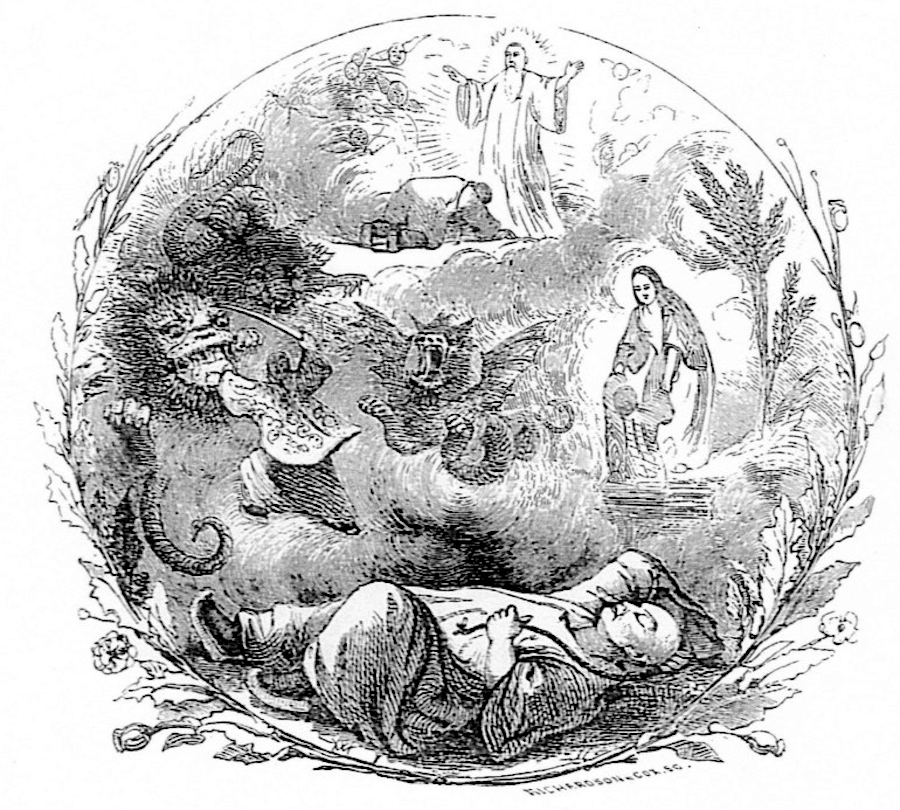
Fig. 4 Hong Xiuquan’s dream, contained in J. Milton Mackie’s The Life of King Taiping-Rebel Leader in China.
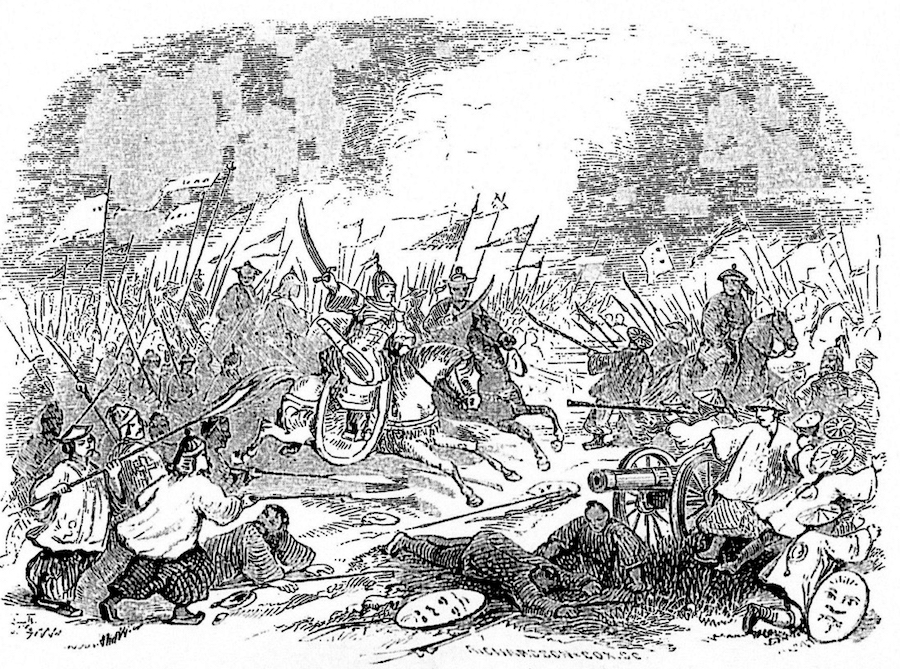
Fig. 5 Taiping Army defeated Qing Army, in J. Milton Mackie’s Life of Taiping King-Rebel Leader in China.
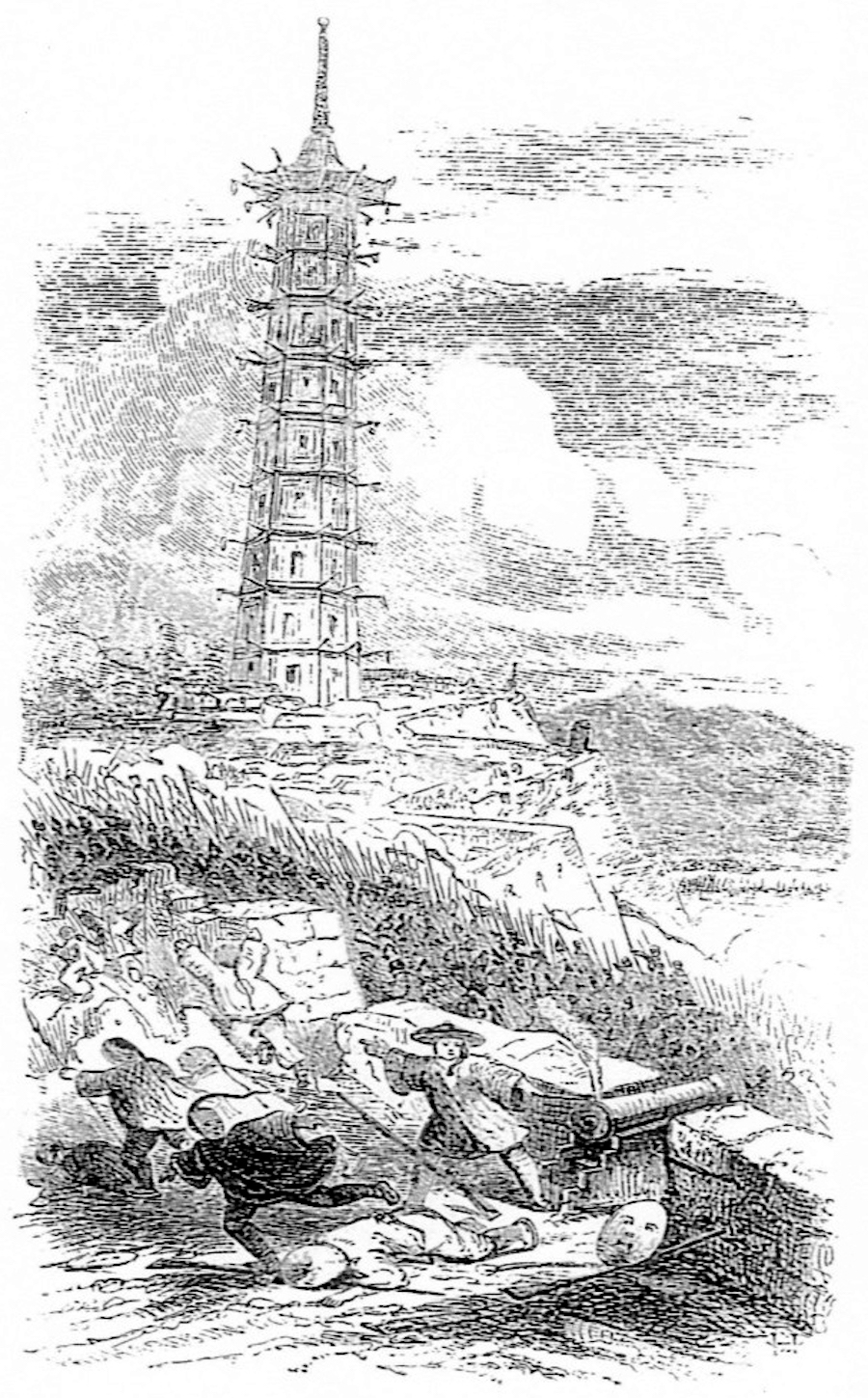
Fig. 6 Taiping Army captured Nanjing, in J. Milton Mackie’s Life of Taiping King-Rebel Leader in China.

Several letters from missionaries are also included in this book. For example, Tian Jiabi, a Catholic bishop, recorded in his letter that people in Jiangxi were expecting the arrival of the Taiping Army in 1852, and Luo Xiaoquan, who received a letter from Hong Xiuquan in 1853, sent a letter to the American Commissioner in China, Mashali, asking about the possibility of missionary work in the areas occupied by the Taiping Heavenly Kingdom. There is also a historical material that was not paid attention to before, which is a letter from Mgr. Rizzolati, Bishop of Huguang Region of Catholicism, to the Central Council in Lyon and Paris, France in August 1853:

They(the insurgent kings)have placed all the resources in a common treasury, and reorganized society on a new plan, that is, in groups of a certain number of persons of both sexes, who are prohibited from cohabiting together, under the most severe penalties. This rule is to be observed until the whole China shall have been conquered. All honorary titles are abolished, except those of officers in the army. The men are to adopt the appellation of brothers, and the women that of sisters. Each family has two chiefs; a man for government of the male members, and a woman for the females; and over all these individual dignitaries a hierarchy is established, comprising general presidents of both sexes. All these confraternities live in common, at the expense of the public treasury; and all of them are bound to perform military service, the men under the command of a male leader, and the women under that of the female; for there are captains of both sexes. After the conquest of the empire, the families, whose military services may no longer be deemed necessary, are to return to their cities, where there is to be no distinction of rich and poor, but perfect equality. However, according to the laws of their communism, the king, the princes, and generals are to have the exclusive right of possession and acquisition, and the subalterns are to remain in the service of their chiefs, and to receive, in reward for these services, such food and clothing as the generosity of their masters may induce them to bestow.(Note C, p.280)

The letter introduced the sacred storehouse system implemented by the Taiping Heavenly Kingdom in Yong ‘an Prefecture, Wuchang and Nanjing, and described the situation of dissolving families, managing separate camps for men and women, denying the gap between the rich and the poor, and implementing "perfect equality" before the Qing Dynasty was completely overthrown. In addition, it is mentioned that kings and generals can get privileges according to the laws they have made, and people serving in their palaces can get clothes and food there. G. J. Wolseley, a British general who visited Nanjing in 1861, also said that "people serve under the flag of their masters, who provide them with daily food, clothes and all daily necessities". Therefore, it can be seen that the ability of the king can be inferred from the degree of support of each palace for its subordinate personnel.

There is also a book "Christianity in China-its missionary history and present rebellion" (The Christianity in China, the history of Christian Missions, and of the present insurrection) in oriental library, and its title page contains portraits of Emperor Xianfeng and Hong Xiuquan (Figure 7). Chapter 12, "The Origin of the Rebellion in China and the Victory and Development of Christianity", introduces the process of the Taiping Heavenly Kingdom at great length. In addition, although there are not many descriptions of the Taiping Heavenly Kingdom in "China Mission, Embracing a History of the Various Missions of All Denominations About the Chinese", there are many biographies of missionaries related to the Taiping Heavenly Kingdom, but Luo Xiaoquan’s biography can’t be found. It is conceivable that Luo Xiaoquan was not highly praised by the missionary groups at that time.
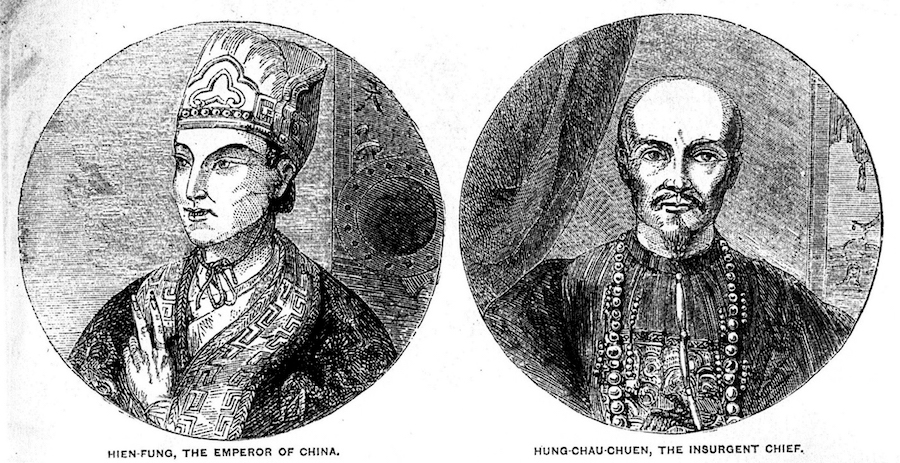
Figure 7: Emperor Xianfeng and Hong Xiuquan, contained in Christianity in China-The History of its Missionary and the Rebellion Now.

conclusion

Based on the English historical materials related to the Taiping Heavenly Kingdom in Nanjing, the capital of oriental library, this paper discusses the understanding of God in Europe. When most of them heard the news that the Taiping Heavenly Kingdom built Nanjing as its capital, they all looked forward to the opportunity for China to become a Christian country. At the same time, they also have many doubts about the Taiping Heavenly Kingdom’s tendency to attach importance to the Old Testament, the slaughter of the flag bearer, polygamy which deviates from European customs and so on.

In fact, the Taiping Heavenly Kingdom attached importance to the Old Testament, which was a direct result of the influence of missionaries in China at that time. As a Hakka, Hong Xiuquan is often treated unfairly because of his status, and naturally he will be strongly attracted by the contents of the Old Testament holy books of Jews who have scattered around the country because of the loss of their motherland. Retaliatory violence caused by the theory of relief of the oppressed people promoted the massacre of flag-bearer idolaters by the Taiping Heavenly Kingdom, and many missionaries who knew about this situation opposed the violent revolution. In addition, among those who have sympathy for the Taiping Heavenly Kingdom, they think that the history of Christianity in Europe is also accompanied by war and violence. Just because the Taiping Heavenly Kingdom is aggressive for the sake of justice for the weak, they cannot be defined as "heresies".

Christopher Lloyd’s What on Earth Happened? In The Complete Story of the Planet, Life and People from the Big Bang to the Present Day, China civilization, as a rare and strong civilization in history, has been highly appraised to this day. But on the other hand, he thought that the Taiping Heavenly Kingdom was "the worst military dispute in human history", and the victims of this war exceeded 20 million. One of the reasons for such a great sacrifice is obviously the relief thought of Jewish-Christian Millennium Kingdom accepted by Taiping Heavenly Kingdom. In the past, such cruel reality was over-beautified, or some people labeled the religion of the Taiping Heavenly Kingdom as a cult, thus exonerating the Jewish relief thought.

Political MV | Love in the Yangtze River

Years ago

  A Song of the Yangtze River

  How many people have been sung?

  Infinite attachment to splendid rivers and mountains

  today

  A song "Love in the Yangtze River"

  Singing the contemporary youth.

  Affectionate praise for a river and clear water.

  "Make the Yangtze River Economic Belt become

  China’s ecological priority green development main battlefield,

  Smooth domestic and international double circulation aorta,

  Leading the main force of high-quality economic development. "
  Standing at the height of history and overall situation

  Proceeding from the long-term interests of the Chinese nation

  General secretary of supreme leader

  Personally plan, personally deploy, and personally promote

  High-quality development of the Yangtze River Economic Belt

  Xinhua News Agency and China Federation of Literary and Art Circles

  Inviting Shu Nan to compose music at the national level.
  Liang Mang, a famous lyricist

  Joined young singer Xilin Nayi Gao.

  Xinhua News Agency reporter Lu Binqi

  Deeply sing a song for the "mother" of the Yangtze River.

  Melting from glaciers and moistening the earth

  To every drop of water that flows into the sea

  In the slowly unfolding audio and video

  It is a grand plan drawn by the rushing river.

  In the lyrics and songs that are eloquent

  It is an oath made by continuous struggle.

  Please listen to the current political MV

  Love in the Yangtze River

  Producers: Liu Jian, Zhu Di

  Artistic Director: Shu Nan.

  Producer: Sun Chengbin and Xie Li

  Producer: Li Jun

  Planning: Chang Ailing, Qi Huijie and Ling Weijia

  Director: Zhou Ning


  Executive Planning: Zhang Shuqi, Liu Hongde and Jiao Xufeng.

  Choreographer Group: Lu Binqi, Cui Yingxin and Xu An 

  Editing group: Ren Jie, Jiang Fuhai, Cui Yingxin, Zhang Yan, Dai Jinxin and Lu Xianzhang.

  Coordinator: Liu Hongde, Liu Dawei, Qu Meng, Wang Jingyun, Xu An, Gao Shuo, Bai Jianan and Chen Xuan.

  Final review/opening calligraphy: Yang Xia 

  Reporter: Ma Xiaodong, Joline, Pan Xu, Zhang Mengjie, Xiong Qi, Li Aibin, Wu Xiaoyang, Sun Min 

  Editor: Dynasty, Guan Kailiang, Sung-woo Yoon   

  Poster: Yin Zhelun


  Song "Love in the Yangtze River"

  Lyrics: Liang Mang               

  Composer: Shu Nan             

  Singing: Xilin Nayi Gao, Lu Binqi       

  Children’s Chorus: Deep Space Boys Choir

  Conductor: Jiang Xiongda

  Performance: Beijing Sun Youth Orchestra

  Mix: Wan Xiaoyuan

  Arranged by Ding Doudou

  Strings: International Chief Philharmonic Orchestra

  Music coordinator: He Tianzuo, Bai Jianan, Gao Hongwei


  Production: Xinhua News Agency New Media Center

  Undertaking: Sister Studio of Xinhua News Agency Xiaolu

  Acknowledgement: Shu Nan Studio.

     the national academy of chinese theatre arts

     Qinghai province radio and television bureau

     Shanghai Radio and TV Station

     Chinese national geography image library

     beijing no.35 middle school


  Produced by Xinhua News Agency, China Federation of Literary and Art Circles

Order of the State Administration of Market Supervision (No.20) Interim Measures for Handling Complaints and Reports of Market Supervision and Management

Order of the State Administration of Market Supervision

No.20

The Interim Measures for Handling Complaints and Reports in Market Supervision and Management was considered and adopted at the 15th executive meeting of the State Administration of Market Supervision in 2019 on November 26th, 2019. It is hereby promulgated and shall come into force as of January 1st, 2020.

Director Xiao Yaqing   

November 30, 2019  

Interim Measures for Handling Complaints and Reports in Market Supervision and Management

(Promulgated by Order No.20 of the State Administration of Market Supervision on November 30, 2019)

the first In order to regulate the handling of complaints in market supervision and management, and protect the legitimate rights and interests of natural persons, legal persons or other organizations, these Measures are formulated in accordance with the Law of People’s Republic of China (PRC) on the Protection of Consumer Rights and Interests and other laws and administrative regulations.

the second These Measures shall apply to the handling of complaints and reports by market supervision and management departments.

Article The term "complaint" as mentioned in these Measures refers to the behavior of consumers who need to buy or use goods or accept services for their daily consumption, and who have a dispute with operators about consumers’ rights and interests and request the market supervision and management department to resolve the dispute.

The term "report" as mentioned in these Measures refers to the behavior of natural persons, legal persons or other organizations to report to the market supervision and management department that operators are suspected of violating the laws, regulations and rules of market supervision and management.

Article 4 The State Administration of Market Supervision is in charge of the handling of complaints and reports nationwide and guides the handling of complaints and reports by local market supervision and management departments.

The local market supervision and management departments at or above the county level shall be responsible for the handling of complaints and reports within their respective administrative areas.

Article 5 When handling complaints and reports, the market supervision and management department shall follow the principle of fairness and efficiency, and ensure that the application basis is correct and the procedures are legal.

Article 6 Encourage the public and the news media to conduct social supervision and public opinion supervision according to law on acts suspected of violating laws, regulations and rules on market supervision and management.

Encourage consumers to negotiate with operators to resolve consumer rights disputes through online consumer dispute resolution mechanisms, consumer rights protection service stations, green channels for consumer rights protection, and third-party dispute resolution mechanisms.

Article 7 If complaints and reports are submitted to the market supervision and management department at the same time, or the materials provided contain both complaints and reports, the market supervision and management department shall handle the complaints and reports separately in accordance with the procedures prescribed in these Measures.

Article 8 Complaints to the market supervision and management department shall be made through the Internet, telephone, fax, mailing address, window and other channels announced by the market supervision and management department to receive complaints and reports.

Article 9 The complaint shall provide the following materials:

(1) The name, telephone number and mailing address of the complainant;

(2) The name and address of the respondent;

(three) the specific complaint request and the facts of the consumer rights dispute.

If the complainant makes a complaint in a non-written way, the staff of the market supervision and management department shall record the information specified in the preceding paragraph.

Article 10 Where a complaint is made on behalf of others, the original power of attorney and the identity certificate of the trustee shall be provided in addition to the materials specified in the first paragraph of Article 9 of these Measures.

The power of attorney shall specify the entrusted matters, authority and time limit, and shall be signed by the client.

Article 11 If there are two or more complainants who complain about the same operator based on the same consumer rights dispute, the market supervision and management department may handle it as a joint complaint with the consent of the complainant.

A joint complaint may be made by two representatives elected by the complainant in writing. The representative’s complaint behavior is effective for the complainant he represents, but if the representative changes, abandons the complaint request or reaches a mediation agreement, it shall be agreed by the represented complainant.

Article 12 The complaint shall be handled by the county-level market supervision and administration department of the respondent’s actual business place or domicile.

Complaints against e-commerce platform operators and e-commerce operators who sell goods or provide services through self-built websites and other online services shall be handled by the county-level market supervision and management department where they live. Complaints against the operators in the platform shall be handled by the county-level market supervision and management department at the place where they actually operate or where the platform operators live.

If the superior market supervision and management department deems it necessary, it may handle the complaints received by the subordinate market supervision and management department. If the lower-level market supervision and management department thinks that it is necessary for the higher-level market supervision and management department to handle the complaints received by the administrative organ, it may report to the higher-level market supervision and management department for decision.

Article 13 If more than two market supervision and management departments have the authority to handle the complaint about the same consumer’s rights and interests dispute, the market supervision and management department that received the complaint first shall handle it.

Article 14 The market supervision and management department with the handling authority as stipulated in these Measures shall, within seven working days from the date of receiving the complaint, make a decision on whether to accept it or not, and inform the complainant.

Article 15 In any of the following circumstances, the market supervision and management department shall not accept the complaint:

(a) the complaint is not the responsibility of the market supervision and management department, or the administrative organ does not have the authority to deal with it;

(2) The court, arbitration institution, market supervision and management department or other administrative organs, consumer associations or other mediation organizations established according to law have accepted or handled the same consumer rights dispute;

(3) Not buying or using commodities or receiving services for the needs of daily consumption, or failing to prove that there is a dispute between consumers and the respondent;

(4) Unless otherwise provided by law, the complainant knows or should know that his rights and interests have been infringed by the respondent for more than three years;

(5) Failing to provide the materials specified in the first paragraph of Article 9 and Article 10 of this Law;

(six) other circumstances that are not accepted by laws, regulations and rules.

Article 16 With the consent of the complainant and the respondent, the market supervision and management department handles the complaint by mediation, but if there are other provisions in laws and regulations, such provisions shall prevail.

Encourage the complainant and the respondent to negotiate on an equal footing and settle on their own.

Article 17 Market supervision and management departments may entrust consumer associations or other mediation organizations established according to law to mediate on their behalf.

The entrusted unit conducts mediation in the name of the entrusted market supervision and management department within the scope of entrustment, and may not entrust other organizations or individuals.

Article 18 Mediation can take the form of on-site mediation or off-site mediation such as Internet, telephone, audio and video.

If on-site mediation is adopted, the market supervision and management department or its entrusted unit shall inform the complainant and the respondent of the time, place and mediator of mediation in advance.

Article 19 Mediation shall be presided over by the staff of the market supervision and management department or its entrusted unit, and relevant personnel may be invited to assist as needed.

If the mediator is a close relative of the complainant or the respondent or has other interests, which may affect the fair handling of the complaint, he shall withdraw. If the complainant or the respondent applies for withdrawal of the mediator, the market supervision and management department shall suspend the mediation and make a decision on whether to withdraw.

Article 20 If verification, inspection, testing and appraisal are needed, the complainant and the respondent shall agree through consultation and jointly entrust a technical institution with corresponding conditions to undertake it.

Unless otherwise stipulated by laws and regulations, the expenses for verification, inspection, testing and appraisal shall be borne by the complainant and the respondent through consultation.

The time required for verification, inspection, testing and appraisal is not counted in the mediation period.

Article 21 In any of the following circumstances, the mediation shall be terminated:

(1) The complainant withdraws his complaint or both parties reach a settlement by themselves;

(two) the complainant and the respondent can not reach an agreement on the technical institutions or the expenses entrusted to undertake the verification, inspection, testing and appraisal work;

(three) the complainant or the respondent does not participate in mediation without justifiable reasons, or the respondent explicitly refuses to mediate;

(four) after mediation, the complainant or the respondent clearly stated that the mediation agreement could not be reached;

(five) the complainant and the respondent failed to reach a mediation agreement within forty-five working days from the date of accepting the complaint;

(six) after accepting the complaint, the market supervision and management department finds that there are circumstances stipulated in Article 15 of these Measures;

(seven) other circumstances in which mediation should be terminated as stipulated by laws, regulations and rules.

If the mediation is terminated, the market supervision and management department shall inform the complainant and the respondent within seven working days from the date of making the decision to terminate the mediation.

Article 22 If a mediation agreement is reached through on-site mediation, the market supervision and management department shall make a mediation agreement, except that the mediation agreement has been immediately performed or both parties agree not to make a mediation agreement. The conciliation statement shall be signed or sealed by both the complainant and the respondent, and stamped with the seal of the market supervision and administration department, and shall be submitted to the complainant and the respondent respectively, and the market supervision and administration department shall keep one copy for filing.

If no conciliation statement is made, the market supervision and management department shall make conciliation records for future reference.

Article 23 If the market supervision and management department finds clues suspected of violating the laws, regulations and rules of market supervision and management in mediation, it shall check them within 15 working days from the date of discovery and deal with them in accordance with the relevant provisions on administrative punishment of market supervision and management. Under special circumstances, the time limit for verification may be extended by fifteen working days. Where laws, regulations and rules provide otherwise, such provisions shall prevail.

Mediation of disputes over consumers’ rights and interests does not exempt operators from other legal responsibilities they should bear according to law.

Article 24 Informants shall provide specific clues suspected of violating the laws, regulations and rules of market supervision and management, and be responsible for the authenticity of the reported contents. Informants who report in a non-written way shall be recorded by the staff of the market supervision and management department.

Encourage operators’ internal personnel to report operators’ alleged violations of market supervision and management laws, regulations and rules according to law.

Article 25 The report shall be handled by the market supervision and management department at or above the county level where the reported behavior occurred. Where laws and administrative regulations provide otherwise, such provisions shall prevail.

Article 26 The agency of the county-level market supervision and management department handles the report in the name of the county-level market supervision and management department within the scope of authority determined by the county-level market supervision and management department, unless the laws, regulations and rules authorize it to handle the report in the name of the agency.

Article 27 Reports on e-commerce platform operators and e-commerce operators who sell goods or provide services through self-built websites and other online services shall be handled by the market supervision and management departments at or above the county level where they live.

The report of the operators in the platform shall be handled by the market supervision and management department at or above the county level where they actually operate. If the market supervision and management department at or above the county level in the domicile of the e-commerce platform operator receives the report first, it may also handle it.

Article 28 Reports of illegal advertisements published by mass media such as radio, movies, television, newspapers, periodicals and the Internet shall be handled by the market supervision and administration department where the advertisement publisher is located. If it is difficult for the market supervision and administration department where the advertisement publisher is located to handle the reports of advertisers and advertising operators in different places, it may transfer the reports of advertisers and advertising operators to the market supervision and administration department where the advertisers and advertising operators are located for handling.

If the market supervision and management department of the place where the advertiser is located or where the advertising operator is located receives the report first, it may also handle it.

Reports of illegal Internet advertisements published by advertisers themselves shall be handled by the market supervision and management department where the advertisers are located.

Article 29 If the market supervision and administration department that receives the report does not have the handling authority, it shall inform the informant to directly submit it to the market supervision and administration department that has the handling authority.

Article 30 If there is a dispute between two or more market supervision and management departments over the handling authority, it shall be settled through consultation within seven working days from the date of the dispute; If negotiation fails, it shall be reported to the common market supervision and management department at the next higher level to designate a handling organ.

Article 31 The market supervision and management department shall handle the report in accordance with the relevant provisions of the administrative punishment of market supervision and management.

If the informant reports with his real name, the market supervision and management department with the handling authority shall also inform the informant within five working days from the date of making a decision on whether to file a case.

Article 32 Where laws, regulations and rules stipulate that the market supervision and management department shall inform the informants of the report processing results or reward them, the market supervision and management department shall inform or reward them.

Article 33 The market supervision and management department shall keep confidential the information of the informer, and shall not disclose the informer’s personal information, the handling of the report, etc. to the informer or any person who has nothing to do with the handling of the report, except that the materials provided include both complaints and reports, and it is necessary to provide the informer with information necessary for organizing mediation.

Article 34 The market supervision and management department shall strengthen the statistics, analysis and application of complaints and reports in this administrative region, regularly publish statistical analysis reports of complaints and reports, and publicize consumer complaints information according to law.

Article 35 The market supervision and management department shall strictly keep confidential the state secrets learned in the handling of complaints and reports and the information that may endanger national security, public safety, economic security and social stability after disclosure.

Involving business secrets, personal privacy and other information, it is really necessary to disclose, in accordance with the "Regulations on the disclosure of government information in People’s Republic of China (PRC)" and other relevant provisions.

Article 36 The market supervision and management department shall unblock the receiving channels of complaints and reports such as the national 12315 platform and the 12315 special telephone, implement unified data standards and user rules for complaints and reports, and realize the integration of complaints and reports information throughout the country.

Article 37 The local market supervision and management departments at or above the county level shall uniformly receive the complaints and reports, and shall promptly distribute the complaints and reports to the lower market supervision and management departments with handling authority or the relevant institutions of the market supervision and management departments at the same level for handling.

The relevant institutions of the market supervision and management departments at the same level shall handle the complaints and reports in a timely manner in accordance with the relevant provisions of these Measures. Do not have the authority to deal with, it should be timely feedback to the unified working mechanism to receive complaints and reports, and shall not be transferred by itself.

Article 38 The market supervision and management department may refer to these measures when handling other complaints filed in accordance with the law except those stipulated in Article 3 of these Measures.

Reporting suspected violations of the Anti-Monopoly Law of the People’s Republic of China shall be implemented in accordance with the special provisions of the State Administration of Market Supervision. Where there is no provision in the special provisions, these measures may be implemented with reference to them.

These Measures shall apply to the handling of complaints and reports by pharmaceutical supervisory and administrative departments and intellectual property administrative departments, except as otherwise provided by laws and regulations.

Article 39 If a natural person, legal person or other organization reflects the administrative fees of state organs, institutions, social organizations acting as government functions and other organizations, it shall be handled in accordance with the relevant provisions of the Regulations on Letters and Visits.

These measures are not applicable to consultation, application for government information disclosure, application for administrative reconsideration, letters and visits, and accusation of discipline inspection and supervision in the form of complaints and reports, and the market supervision and management department may inform them to put forward through corresponding channels.

Article 40 These Measures shall come into force as of January 1, 2020. The Measures for Handling Product Quality Complaints promulgated by Order No.51 of the former State Bureau of Quality and Technical Supervision on March 12, 1998, the Measures for Handling Consumer Complaints by the Administration for Industry and Commerce promulgated by Order No.62 of the former State Administration for Industry and Commerce on February 14, 2014, and the Administrative Measures for Reporting Food and Drug Complaints promulgated by Order No.21 of the former china food and drug administration on January 12, 2016 shall be abolished at the same time.

India’s annexation of Sikkim, will Nepal and Bhutan follow suit?

The original global intelligence agent Global intelligence agent is included in the topic # South Asia Insight 1

Indonesia’s relations with three countries

Author | Blue Sky and Clear Away

Editor | |Thomas

As a major country in South Asia, India accounts for 70% of the local area and 75% of the total population in South Asia. With its volume advantage, India has always claimed to be the hegemon of South Asia.

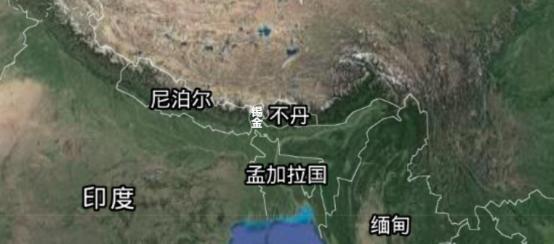
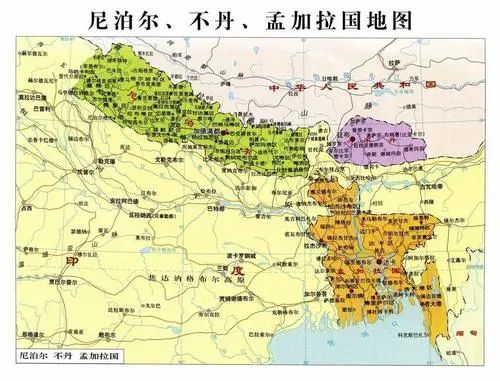
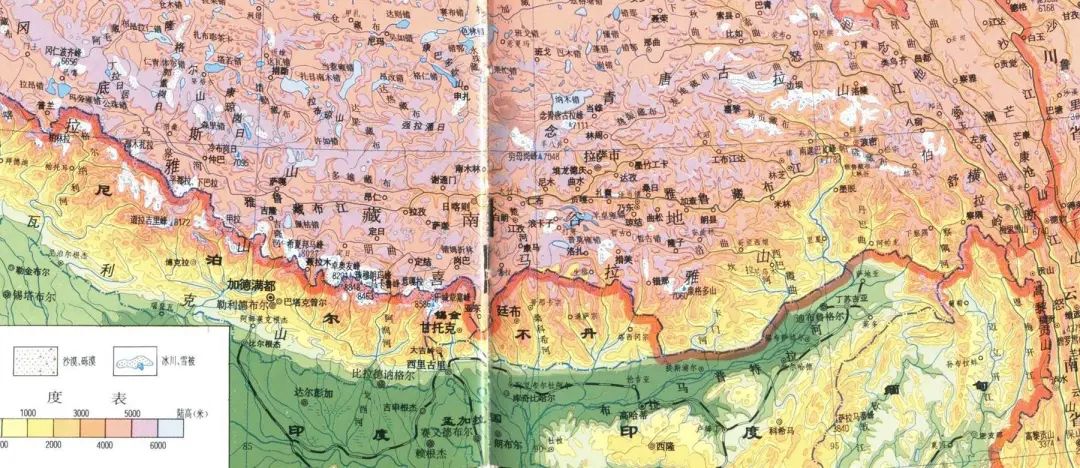
Apart from Pakistan, India exerts varying degrees of influence on other countries in South Asia, especially Nepal and Bhutan in the southern foothills of the Himalayas.

Due to traffic congestion, the import and export channels of Nepal and Burundi are controlled by India, and they rely on India in many fields such as economy and energy, and they can never get rid of India’s control politically.

▲ India is a giant in front of other countries in South Asia.

The combined population of the two countries accounts for only 2% of India, and the combined territory accounts for 6% of India. India exerts all-round control over the two countries in economy and diplomacy. There was once a country called Sikkim between Nepal and Bhutan, which was openly annexed by India in the 1970s.

What is the difference between India-controlled Nepal and Bhutan and Sikkim? Can they follow the old path of Sikkim and be annexed by India?

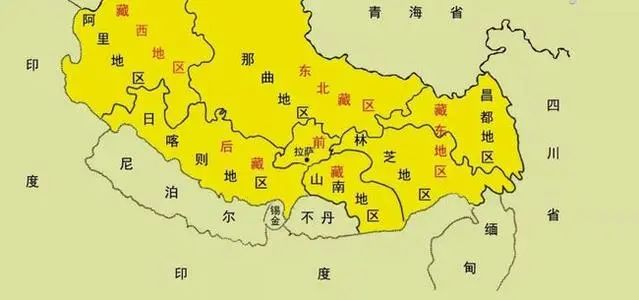
▲ All three countries are close to Xizang.

First, the undercurrent under the Himalayas

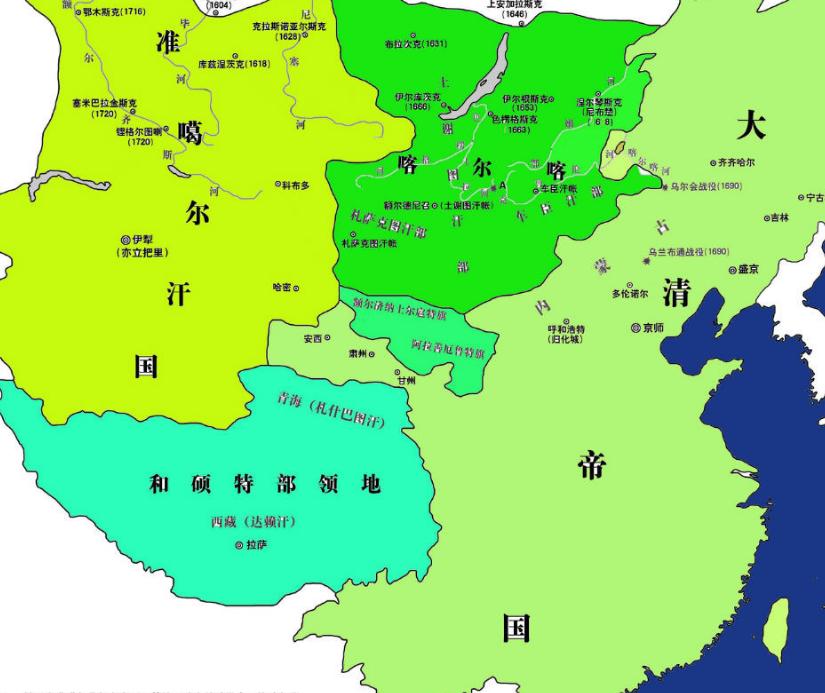
Since ancient times, the towering Himalayas have been the political and geographical dividing line between the traditional East Asian dynasty and the South Asian regime. During the Tang Dynasty, the powerful Tibetan army once crossed the mountains and went south to drink horses in the Ganges Plain. During the Yuan and Ming Dynasties, the Qinghai-Tibet Plateau was incorporated into the political system of the Central Plains Dynasty, but the control over the Qinghai-Tibet Plateau in the Ming Dynasty was far less than that in the Yuan Dynasty.

In the first half of the seventeenth century, the peasant uprising and foreign invasion made the Ming dynasty busy. Mongolians living in Qinghai, Xinjiang and other places entered Xizang, and they cooperated with Tibetan factions to compete for control of Xizang.

▲ Xizang in the early Qing Dynasty

The turbulent situation caused many monks and nobles to leave Xizang. Awang Langjie, a religious figure of the Kagyu Sect of Tibetan Buddhism (one of the four major sects of Tibetan Buddhism), led his followers to Bhutan, which is located on the border of Xizang, and established his own religious kingdom here in 1616.

In 1642, located in Zhemengxiong area in the west of Bhutan, the local religious forces established the Sikkim Kingdom with the descendants of Xizang nobles living here. Since then, Bhutan and Sikkim have been transformed into independent feudal kingdoms from the border areas of Xizang.

▲ Bhutan’s culture and architecture are similar to those of Xizang.

Bhutan and Sikkim were founded, but the local government in Xizang still maintained great influence on the two countries. After the change of dynasties in Ming and Qing Dynasties, the Qing Dynasty allowed the local government of Xizang to have its own vassal state, and Bhutan and Sikkim were the vassals of Xizang. The local culture is no different from that of Xizang, and Tibetan Buddhism is also an unquestionable national belief.

Bhutan and Sikkim are the marginal areas of Xizang’s cultural influence, and the altitude will decrease rapidly further south. This is the endless Ganges Plain. Although there has been no "unified" dynasty in the Indian Peninsula for centuries, Hindu belief is the undisputed protagonist here.

▲ Almost all the three countries are mountainous, and only the south facing India is the plain.

Nepal also rose rapidly in the 18th century. It used to be the birthplace of Buddhism, but after thousands of years of development and evolution, Nepal has different characteristics from Bhutan and Sikkim, two "Xizang-style" countries.

The influence of Buddhism in Nepal has gradually declined, but because it is closer to the core area of Indian culture, a large number of Indians moved to Nepal to escape the war or for pilgrimage. This also makes Nepal’s population composition more complicated. There are both Xizang-faced mountain aborigines and South Asian-faced immigrants among the residents.

The mixed race born after the combination of the two also occupies an important position in Nepalese society, which injects cultural genes different from Bhutan and Sikkim into Nepal, and even India’s caste system is copied in Nepal.

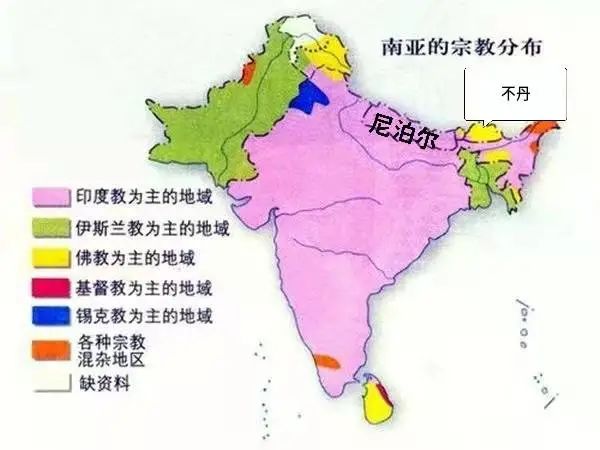
▲ The composition of religions in South Asia is complex.

In the 16th century, Mughals who believed in Islam invaded India to establish political power. Islam immediately spread widely in the northwest of Indian Peninsula and Bangladesh in the lower reaches of Ganges River. Islamic belief has also been introduced into Nepal, but it has not changed the mainstream position of Hindu culture.

In the early 18th century, the Mughal Empire, which ruled most of the Indian Peninsula, began to decline. The country has once again fallen into war, and European colonists led by Britain have also taken advantage of the situation to turn more and more areas on the Indian Peninsula into their own colonies.

In 1772, the British who occupied Bangladesh invaded Bhutan, forcing Bhutan to cede a large territory in the south to Britain. But at this time, the British have limited energy and have not targeted the three Himalayan countries for the time being.

▲ Bhutan is close to Bangladesh

In 1788, Nepalese troops annexed Sikkim, and the Sikkim royal family was forced to flee to Xizang to take refuge. Shah (King) of Nepal has long heard that there are a lot of treasures hidden in the major Buddhist temples in Xizang. Before that, Nepal also had contradictions in the exchange of money and land distribution with the local government of Xizang, and the Nepalese simply turned their troops to invade Xizang.

The Tibetan army was unable to resist, and many towns on the border were captured by the Nigerian army. The Minister in Tibet of the Qing Dynasty and the upper echelons of Xizang made peace with Nepal privately. After receiving the promise of compensation, the Nepalese army withdrew from Xizang.

▲ Pinggurkha

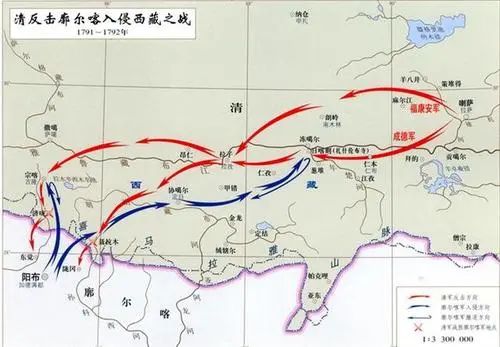
But the Nepalese did not wait for the reparations, and the angry Shah of Nepal led the army into Xizang again. After they occupied it, they hid and looted Tashilhunpo Temple, the Panchen Lama’s residence. The Nepalese behavior annoyed Emperor Qianlong, who ordered Fu Kangan to lead the army into Tibet, and the Qing army went all the way to Kathmandu, the capital of Nepal. Nepal was forced to surrender and recognized the suzerain status of the Qing Dynasty.

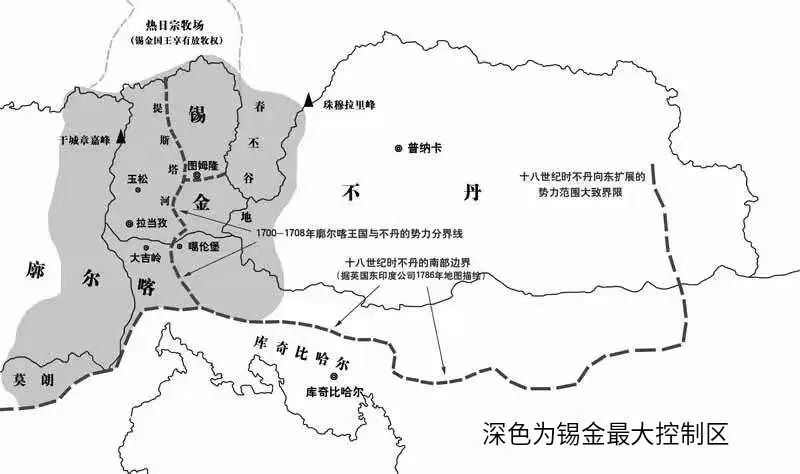
After this battle, Sikkim annexed by Nepal was restored to the motherland, but the western part of Sikkim was still controlled by Nepalese. During the war, Bhutanese also occupied backstab Sikkim, occupying part of the territory in the east of Sikkim. After the restoration of the country, the territory of Sikkim has shrunk a lot, inevitably becoming the weakest of the three mountainous countries.

▲ Smaller and smaller Sikkim

Nepalese who failed to go north began to plan to invade India south, and India’s political division gave Nepal an excellent opportunity to invade. By 1814, Nepal had conquered many areas north of the Ganges. But the Nepalese were not happy for long because they had a head-on collision with the British going north.

Nepali expansion blocked the trade between the British colony and Xizang, and the British did not want a strong local regime to emerge in the South Asian subcontinent. In 1814, the British used the border dispute as an excuse to launch a war against Nepal. The Nigerian army was weaker than the British in terms of strength and equipment, and finally had to surrender.

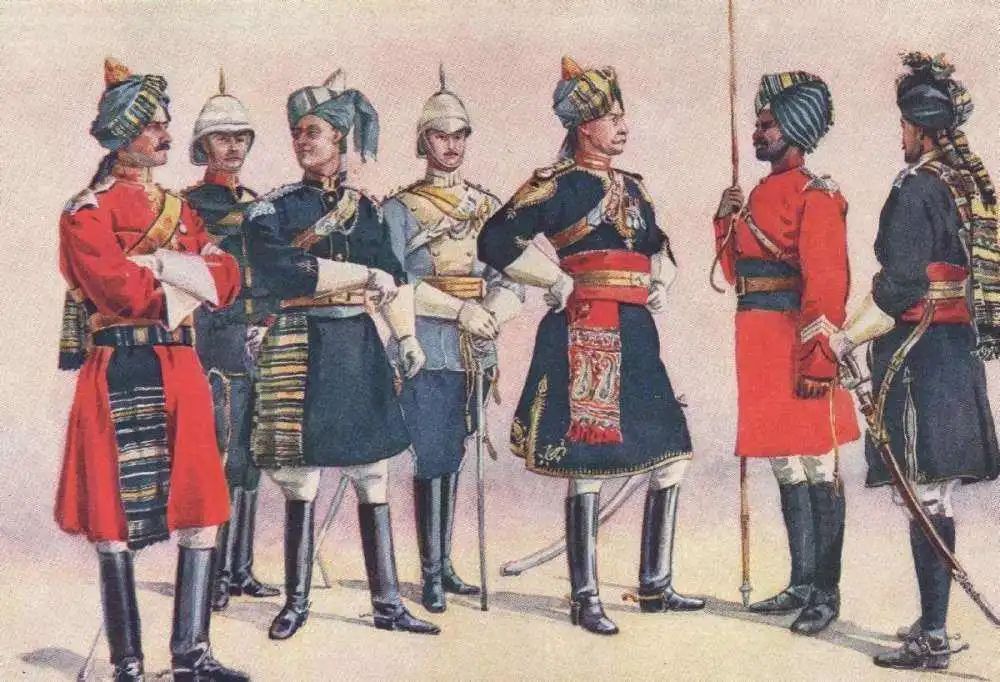
▲ British-Indian colonial army

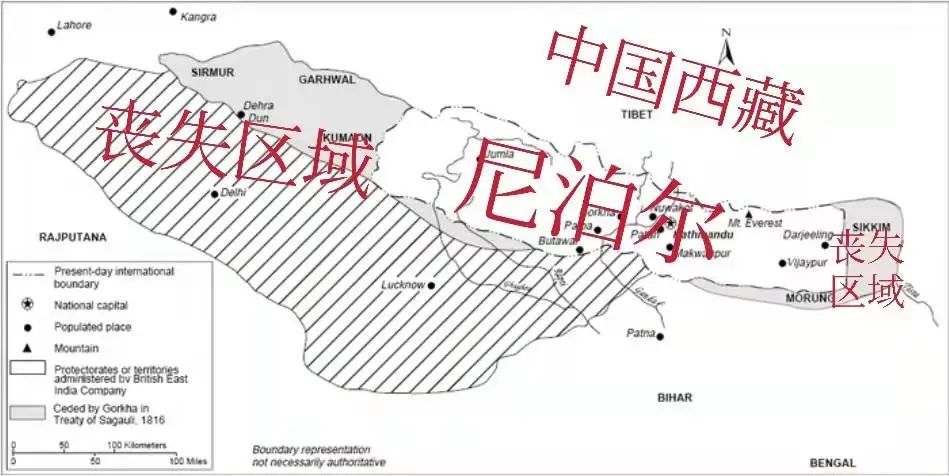
The Sagory Treaty signed by Britain and Nepal made Nepal pay a heavy price. One third of its territory was ceded to the British East India Company, and a large area of land attached to Nepal north of the Ganges River was also taken away by the British. In this way, the British curbed the expansion momentum of the Nepalese and further consolidated their power in the Indian Peninsula. The Gurkhas of Nepal also began to provide high-quality troops for the British army.

The British will not stop there. Nepal, Bhutan and Sikkim will be forcibly dragged into modern society by the British, and the history of national independent development will be interrupted.

▲ Treaty of Sagory

Two, three-pronged approach

While Britain subdued Nepal, the British East India Company reached into Sikkim on the pretext of mediating the territorial dispute between Nepal and Sikkim.

In 1835, the British asked Sikkim to lease Darjeeling and other places in the south, but Sikkim was weak and had to agree to the lease request. The British immediately introduced a large number of Indian and Nepalese laborers to Darjeeling to promote tea cultivation there. Because of its important geographical position, Darjeeling has also become an important bridgehead for Britain to control the three mountainous countries and even to leave Tibet, China.

▲ Darjeeling has become an Indian territory.

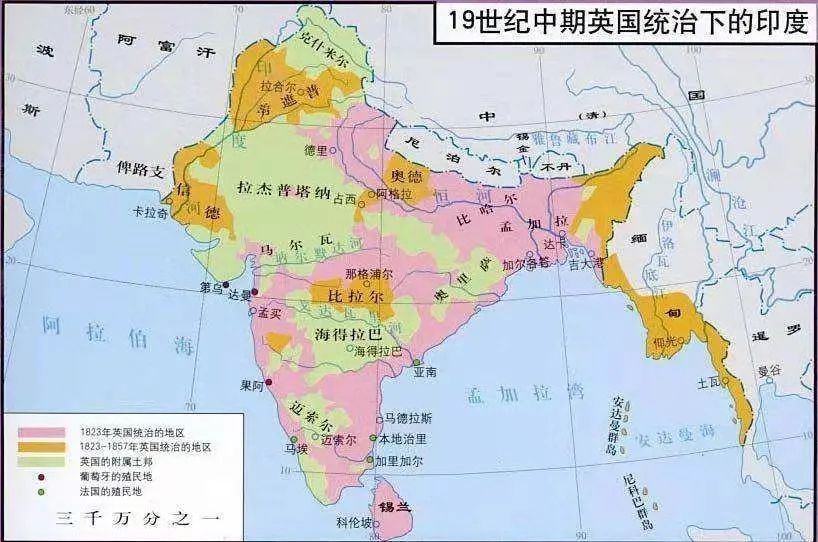
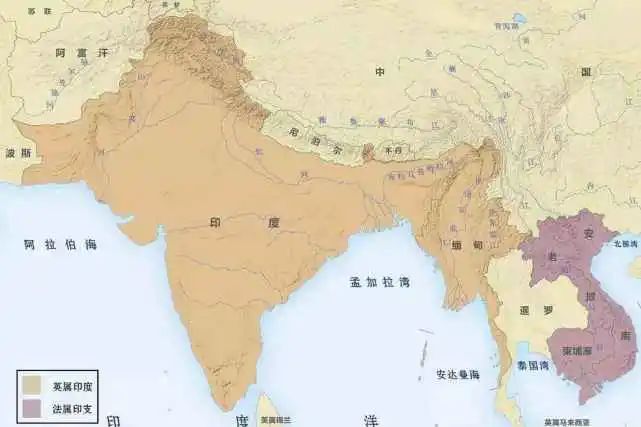
In 1858, the jurisdiction of the British East India Company over Indian colonies was abolished. The British government began to exercise direct rule over India and British India was formally established.

In British India, in addition to the British colony, it also includes a large number of soil states. Tubang retained the original ruling family, but in fact it has become a vassal of the British. After integrating the colonial system on the Indian peninsula, the British set their sights on three small countries under the Himalayas.

▲ British India

The British carried out different expansion and control policies towards the three countries. For Nepal, which has the largest volume, the British support the pro-British faction to master the Nepalese regime and bring Nepal into the sphere of influence. But Britain did not annex Nepal, only regarded it as the northern barrier of British India. Nepal’s upper class also completely fell to the British. He helped the British suppress the British Indian resistance activities, and even repeatedly harassed the Tibet, China border with the encouragement and support of Britain.

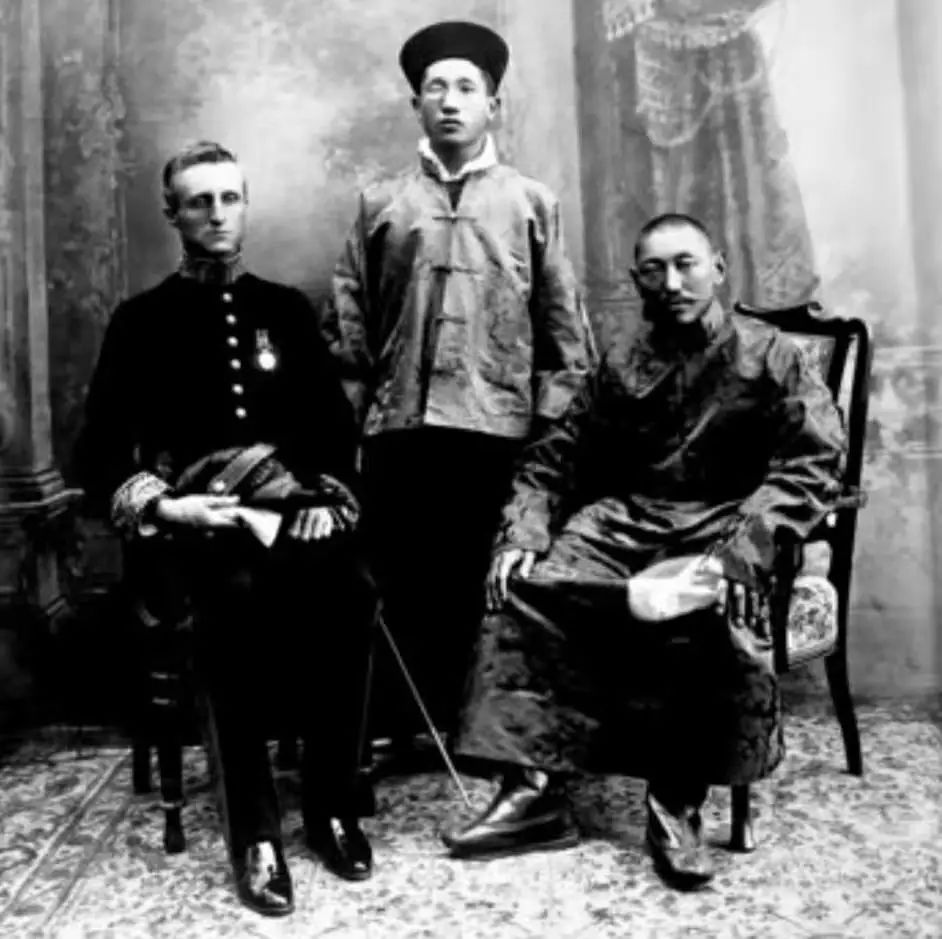
For the weakest Sikkim, in 1861, the British forced Sikkim to hand over diplomatic rights. Since then, in 1889, Britain set up an "Administrative Officer in Sikkim", who was the actual controller of Sikkim, the king of Sikkim was put on hold, and Sikkim became a British protectorate.

▲ The Administrative Officer (left) is sitting, and King Sikkim is standing.

As for Bhutan, because it is located on the trade route from India to Xizang, British India controls a large area of land in southern Bhutan in the form of lease. In addition, the British continued to encroach on the remaining territory of Bhutan, which eventually led to the war in 1864. The Bhutanese army was no match for the British army at all, and the British completely incorporated the previously leased or encroached land into British India.

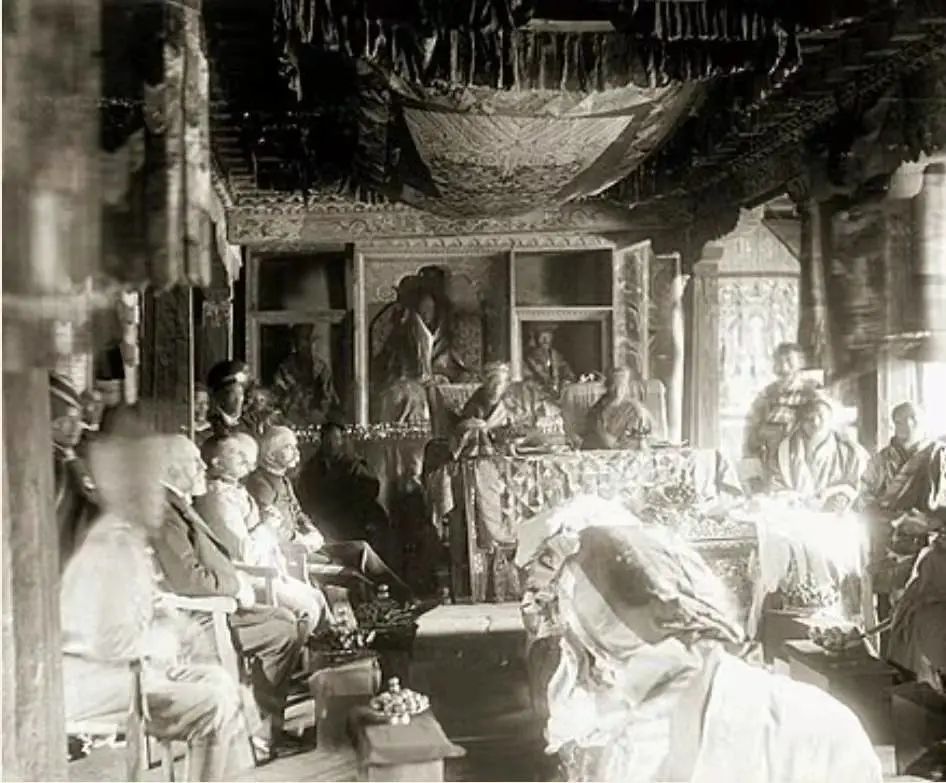
Since then, Bhutan’s political situation has also been controlled by pro-British factions. In 1910, Britain did not sign the Punaka Treaty, and Bhutan handed over diplomatic rights to Britain and became a British protectorate.

▲ Britain does not negotiate.

Although all three countries are included in the British sphere of influence, they are still nominally independent countries. The Three Kingdoms are not directly under the jurisdiction of the British, nor are they Indian territories, which are essentially different from the colonial nature of British India.

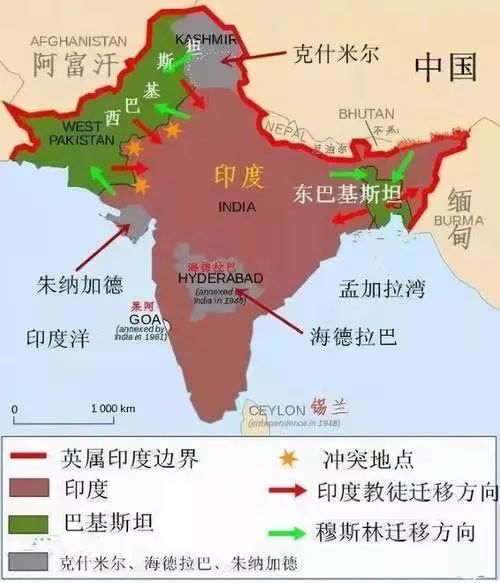
In 1947, the British, whose strength was damaged in World War II, were forced to leave South Asia. Lord mountbatten, Governor-General of British India, put forward the "partition of india" plan. The Hindu-majority areas in its directly administered colonies belong to India, and the Muslim-majority areas belong to Pakistan. The native states of former British India are free to join India and Pakistan.

▲ partition of india

India and Pakistan did not give the maharaja a a choice. For those princes who want to be independent, the Indian and Pakistani troops choose to give them physical elimination. Pakistan, for example, annexed Karat State, which declared independence, by force, while India annexed Hyderabad State, which was similar in size to Britain.

The British plan makes the sensitive religious issues more complicated, and the contradiction between Muslims and Hindus is getting deeper and deeper. Nepal, Bhutan and Sikkim do not belong to British India, but Indians have completely inherited the influence of the British and still control the three mountainous countries.

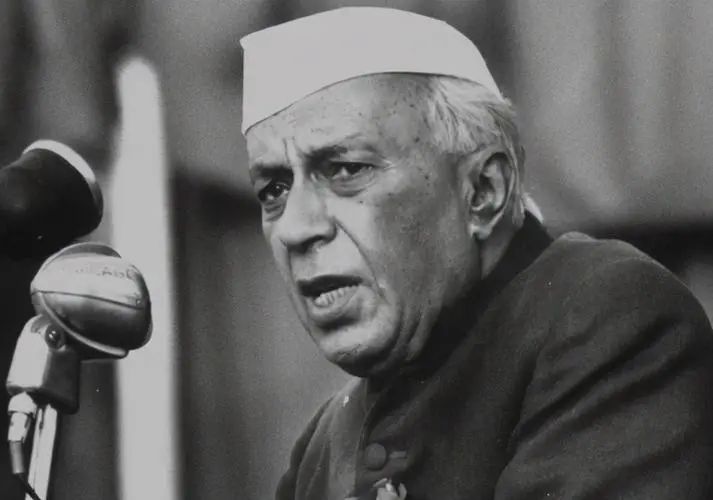
▲ Indian Prime Minister Nehru

In order to establish India’s dominant position in South Asia and strengthen its control over the three mountainous countries. In 1950, India and Nepal signed a friendship treaty, which stipulated the free movement of people and goods between the two countries. The influx of Indians has squeezed the limited local resources, and the trade with India accounts for 95% of Nepal’s total trade. Nepal’s economic dependence on India is getting stronger and stronger.

Bhutan was also forced to sign a similar treaty with India, and its diplomacy was "guided" by India. Bhutan’s government is full of various Indian consultants, and India has taken control of Bhutan’s core sectors such as transportation and finance. India even sent teachers to Bhutan to let this country with rich Tibetan culture receive Indian education.

▲ Bhutanese children

Sikkim is the worst of the three countries. Because of its small country and few people, India immigrated to the local area unscrupulously, which changed the local ethnic composition. Indians have inherited the post of "Administrative Officer in Sikkim" established by the British, and the Indian Administrative Officer is like the emperor of Sikkim.

In this way, India took over the mantle of the British, established a "special relationship" with the three countries, and brought the three countries into its sphere of influence.

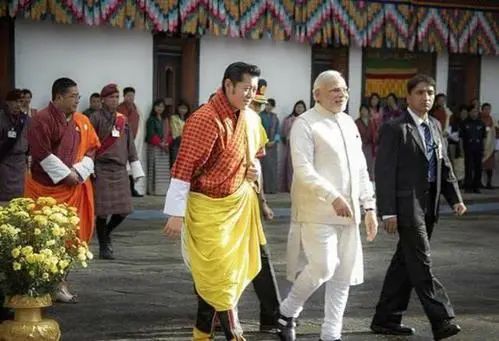
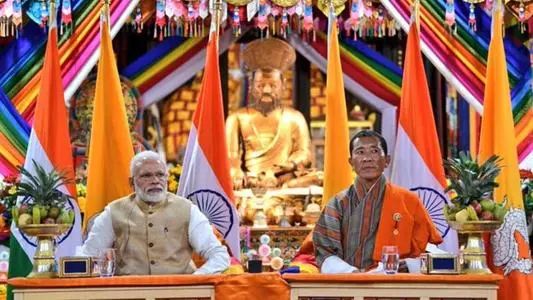
▲ Indian Prime Minister visits Bhutan

Third, the counterattack of fish

India’s control has aroused resentment among the three countries, among which Nepal, with an area of about 150,000 square kilometers and a population of more than 20 million, is undoubtedly the strongest among the three countries. Nepal has also become the hardest of the three countries.

Nepal actively developed its diplomacy with the United States and China, and the King of Nepal asked India to withdraw its military advisory group in Nepal and the personnel of the monitoring station on the border between China and Nepal, and even bought military equipment from China.

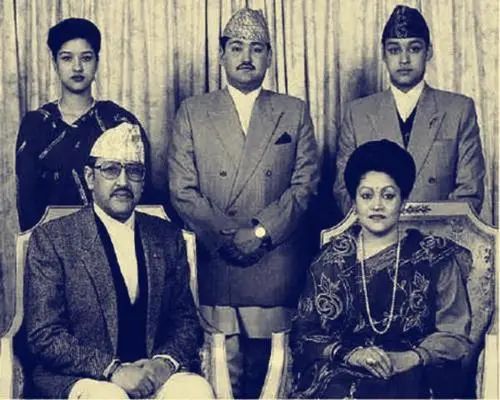
▲ Nepalese royal family

However, more than 40% of the population in Nepal is descended from the combination of India and local aborigines, and 80% of the population in Nepal also believes in Hinduism. In addition, there are a large number of Indian immigrants in Nepal, who do not want Nepal to be excessively separated from India.

The Indian government has also cancelled its financial subsidies to Nepal and imposed a blockade on Nepal’s foreign trade. By the 1960s, the struggle between control and anti-control between Nigeria and India had become superficial.

Bhutan covers an area of less than 40,000 square kilometers, which is similar to that of Taiwan, China. Although there are almost all Buddhists in China, the total population is less than one million. I really don’t have the strength to harden India. On the basis of not denying India’s "guiding right" to its diplomacy, the Bhutanese government stated that "Bhutan has the freedom not to accept India’s opinions in foreign affairs".

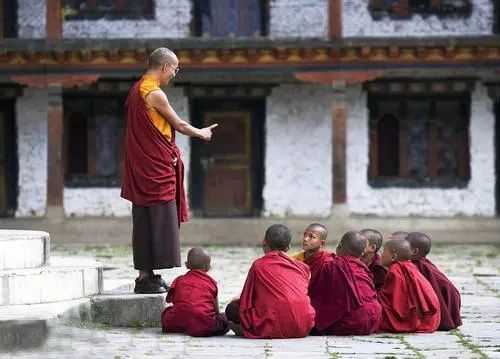
▲ The monks in Bhutan seem to be not much different from Xizang.

Bhutan also demanded to reduce the number of Indian consultants, and in 1971, it issued its own currency, Numza, in an attempt to weaken India’s overall control over Bhutan’s finance.

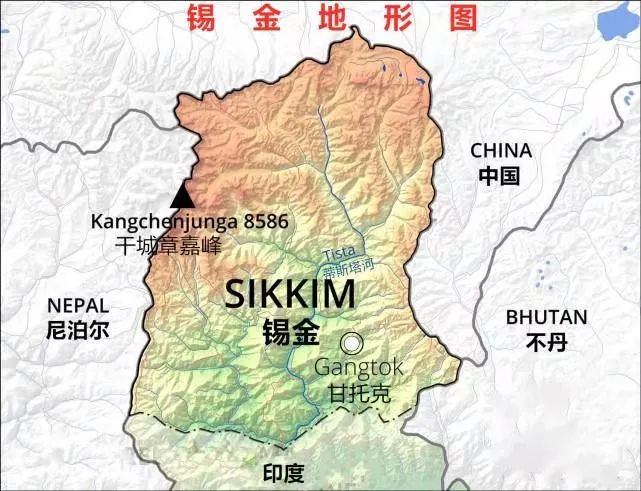
The strength of Sikkim is even weaker, with a total area of only 0.7 million square kilometers, which is not much bigger than that of Shanghai. In the 1970s, the population was less than half a million. Originally, Buddhists were the dominant population, but as a result, the proportion of Buddhist population was continuously reduced with the influx of a large number of Indians.

▲ Sikkim

In 1968, King Sikkim secretly supported people to take to the streets to protest against Indian control. In order to prevent Sikkim from going astray, India "guided" the Sikkim Parliament to pass the Sikkim Constitution drafted by India.

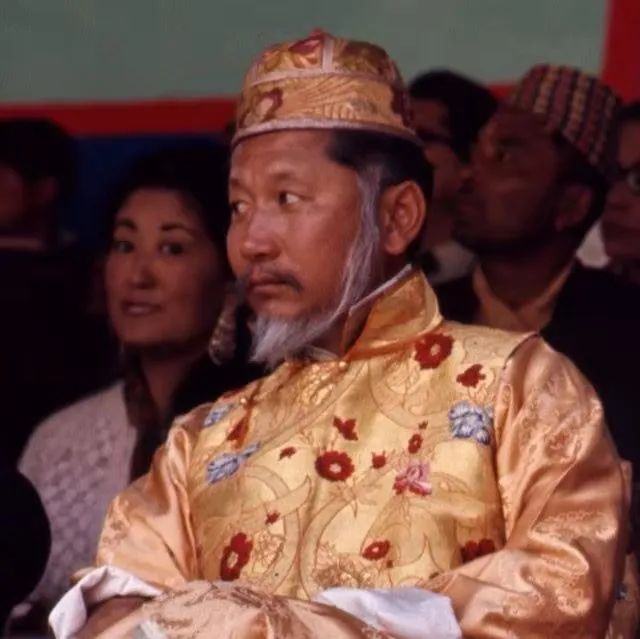
King Sikkim refused to let the country fall into the hands of India, and boycotted the pro-Indian political parties in the next year’s general election. In March 1975, the Indian army surrounded the palace and placed the king under house arrest, and immediately held a referendum to decide whether Sikkim should be incorporated into India. At this time, half of Sikkim’s population were Indian immigrants. Under the "protection" of the Indian army, the referendum decided to merge Sikkim into India with a support rate of 97%.

▲ Sikkim’s last Kejia (King)

In the Cold War, the United States and the Soviet Union acquiesced in India’s annexation of Sikkim in order to win over India. However, this has aroused the worries of Nepal and Bhutan. In 1975, the King of Nepal announced that he would make his country a "zone of peace", adhered to the principle of non-alignment, and opposed the establishment of military bases in Nepal by other countries. Bhutan also joined the United Nations in 1978 and actively integrated into the international arena.

The actions of Nepal and Burundi cannot fundamentally lift India’s control over the country. Nepal is restricted by geographical conditions and its trade is concentrated on the southern side of the border with India. Despite the unremitting efforts of the Nepalese government, its foreign trade has shown a diversified momentum, but by 2020, its trade with India still accounts for about 60% of its total trade, and India’s position in Nepal’s economy and society remains unshakable.

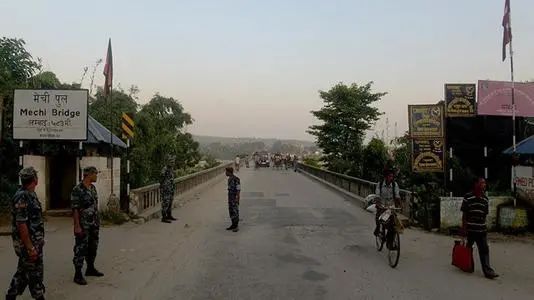
▲ Nepal-India border crossing

The acceptance of Hinduism in Nepal is also getting higher and higher, and the similar cultures of the two countries are an invisible bond. Moreover, Nepal plays an important role in India’s national security strategy, guarding the security of northern India, and India will not let Nepal get rid of the shackles of "special relations."

Bhutan is much smaller than Nepal, and its centrifugal force to India is much smaller. The two countries have frequent high-level visits and close economic and trade relations. In Bhutan’s past ten five-year plans, India has invested more than 50 billion rupees, accounting for more than 60% of the total plan funds.

▲ Bhutan street

Today, 78% of Bhutan’s imported goods come from India, and 94% of its exported goods are also destined for India. More than three-quarters of Bhutan’s annual foreign financial assistance is provided by India. India has supported the development of Bhutan’s power industry, making it a pillar industry, contributing 12% of Bhutan’s GDP, and almost all of this power has been delivered to India.

The weapons, equipment and logistical support of the Bhutanese army are provided by India. There are a large number of Indian army consultants in the Bhutanese army, and Bhutanese officers will also go to India for military training.

▲ India does not have military exchanges.

It should be noted that the tragedy of Sikkim’s annexation will be difficult to perform in Nepal and Bhutan. Compared with Sikkim, Bhutan and Nepal are bigger, and Nepal’s population of 30 million should not be underestimated. India’s internal ethnic contradictions are constant, but the annexation of the two countries will make India’s ethnic problems more complicated. Nepal, with its mountainous areas and fierce folk customs, may become "India’s Afghanistan".

Secondly, it is difficult for India to find the international environment when it annexed Sikkim in 1975. Nepal and Bhutan are members of the United Nations, but once it is annexed, it will inevitably lead to a strong rebound from the international community. Moreover, through existing means, India has maximized its interests in Nepal and Bhutan.

▲ Gurkhas in Nepal provide high-quality mercenaries for Britain, India, Singapore and other countries.

India is not the only neighboring country between Nepal and Bhutan, but their borders with their northern neighbors are all towering snow-capped mountains. Nepal’s 15 major foreign trade ports are all located on the Indian border. India closed 13 of these ports in the diplomatic dispute between Nepal and India in 1989, which caused turmoil in Nepal. In 2019, India cut off Nepal’s oil supply again, and the lives of Nepalese people were seriously affected.

Bhutan’s economy is limited, but India’s penetration control over it has penetrated into all levels of the country, and it is impossible for Bhutan to move the Buddha of India out of its own house on its own. India will remain under the control of the two countries for a long time to come, and this special state-to-state relationship will continue to exist.

▲ Modi visits Bhutan

Long-term author | Blue sky and clear distance

A veteran lover of history

Editor in charge | |Thomas

Graduate of London School of Economics and Political Science | Editor-in-Chief of Global Intelligence

—(End of full text)—

This article is the original content of "Global Intelligence Agent"

Unauthorized reprinting is prohibited.

Welcome and share in the circle of friends and friends.

Original title: "India’s annexation of Sikkim, will Nepal and Bhutan follow suit?" 》

Read the original text

Extra-large series of rice smuggling cases solved

Recently, Chengdu Customs cracked a serious series of rice smuggling cases, destroyed 5 gangs involved and arrested 19 suspects. After preliminary investigation, it was found that the five gangs involved colluded with Yunnan rice smuggling gangs and sold 7,784 tons of smuggled rice from Vietnam, Myanmar and other countries, valued at 38.4 million yuan, and were suspected of evading state taxes of 17.35 million yuan.

Chill! "Star Wars" or the realization of US military ambitions is the poison of outer space peace.

       CCTV News:To pay attention to NATO’s space strategy. At the NATO defense ministers’ meeting held a few days ago, NATO adopted the first framework space strategy in history, and plans to officially launch the space strategy at the NATO summit scheduled for the end of this year, clearly listing space as a battlefield field alongside land, sea, air and network. Regarding the reasons for putting forward the space strategy, NATO officials once again talked about Russia, claiming that this is to cope with the growing space military strength of Russia and other countries.

       Reuters reported that NATO defense ministers reached an agreement at the Brussels meeting on June 26th and 27th, agreeing to formulate a space strategy. NATO member states will hold a meeting in London, England on December 3rd, when it will be officially recognized that member states can wage war not only in the fields of land, sea, air and network, but also in the field of space. The report quoted a senior NATO diplomat as saying: Although the relevant policies are still being discussed and formulated, the member States have basically reached a consensus on the decision to list space as a battlefield.

one

       In June 2018, NATO tried to launch a space strategy, but at that time it failed because of great differences between the parties, and finally released NATO’s first Joint Air Force Strategy. Some NATO member states believe that it is not cost-effective to promote the militarization of space. Trump’s previous announcement of the formation of a space force was opposed and criticized by the Pentagon and the US House of Representatives Armed Services Committee. If you follow the United States, it is likely that the loss will outweigh the gain.

       However, although NATO countries failed to reach an agreement on formulating a space strategy at that time, NATO’s "Joint Air Force Strategy" proposed that NATO should develop "Joint Air Force" in a "balanced and innovative" way, not only to continuously strengthen the anti-strike capability of space-based military facilities, but also to strengthen the utilization of these military facilities, which is the key goal of NATO’s future development. At that time, it was considered as a basic blueprint for NATO’s future development of space power.

one

       The U.S. government once threatened that the United States would occupy a "dominant position" in space, and other NATO countries flocked to it. Despite their differences, they still collectively please the United States. In the future, under the leadership of the United States, NATO may continue to further promote the militarization of space, so that "space NATO" can be transformed from a theoretical concept into a reality.

       But the United States must be clear that "absolute security" that cannot be achieved on land, sea and air will never be achieved in space. The absolute security sought by the United States simply does not exist, which will only further expand the strategic game and military confrontation with Russia into the space field, aggravate world turmoil, create more security dilemmas and bring more security risks. The "Star Wars" that once made human society shudder may become a reality in the future.

       Achieving win-win cooperation in the use of outer space is the general trend of the times. America’s military ambition in space can only be a poison to destroy peace and tranquility in outer space and ruin the original intention of outer space exploration. Whether other NATO countries continue to be at the mercy of the United States and play with fire, or focus on the general trend of the times and cherish peace, it is worth thinking twice.

Background System: Inventory Management System (2)

In the last article, the design points and modules of the warehouse management system were introduced as a whole, but now this article will detail the design process from the actual design.

As mentioned before, warehousing mainly includes: purchase, transfer and return warehousing, while delivery includes sales and transfer delivery. Taking warehousing as an example, the status of each process in the design and the required information are introduced in detail below.

Procurement is mainly divided into three stages: before submission, after submission and receipt. At each stage, it is necessary to show their corresponding status, so that relevant personnel can monitor and track it in time.

Before submission:Filling in a purchase application usually contains a lot of goods. If you fill it out and don’t want to submit it for the time being, you need to provide a save-only function. The warehouse keeper can edit it next time and then submit it.

Application submission/review stage:Basically, there will be many warehouses in an enterprise, and the procurement is usually centralized and unified by a special department or personnel. Therefore, after the person in charge of each warehouse submits the purchase demand, there may be a review process. After the review is passed, the buyer will initiate the purchase from the supplier. Points to note are as follows:

  • Need to consider the permissions between different roles, such as the permissions between the applicant and the reviewer and the page difference. Whether the warehouse and procurement are in the same system, if not, what data interaction and transmission are needed between the systems;
  • After the buyer submits the application, whether it is necessary to make a message notice to remind the auditor to review it in time, or whether it is necessary to directly display the contact information of the auditor on the page, and whether it is possible to contact the auditor directly if the purchase order is in a hurry;
  • Whether it is necessary to provide an entrance for re-application when the application is rejected;
  • In the process of approval, what values need to be filled in by the auditor, what values can be modified, and what values need to be returned to the applicant after modification;

Waiting for receipt: In this state, whether to return goods and whether to need logistics information depends on the demand;

Confirm receipt:After the arrival of the goods, it is necessary to confirm the receipt of the goods, which means that the purchase is completed.

  • Receiving goods in batches:When filling in the purchase order, many goods may be filled in, and the quantity will be relatively large. However, in actual delivery, the goods may be delivered separately, which requires support for receiving goods in batches.
  • Not arrived/out of stock:At the time of receiving goods, there may be some goods missing, which needs to be marked at the time of receiving goods in order to continue tracking. At this point, you need to consider the possible operations in actual business operations, such as the next replenishment or direct refund, or other circumstances. No matter what kind of operation, you need to have an operation record or explanation to facilitate financial reconciliation;
  • Attachment information:When receiving the goods, consider whether it is necessary to upload some document pictures as the receipt voucher. (depending on the needs of relevant departments)

Refers to the information that needs to be displayed on the purchase order, mainly including commodity information, relevant personnel and required number. (depending on the business)

What specific states will exist depends on which warehouse is the initiator.

  • The initiator is the receiving warehouse: similar to the above procurement process, it still needs approval and receiving status;
  • The initiator is the delivery warehouse: the warehousing warehouse only needs to wait for receipt directly, and it is not necessary to display the status before receipt;

In addition to the information mentioned in the purchase, it is also necessary to indicate the delivery warehouse.

Under normal circumstances, this kind of situation is a return application initiated by the buyer, but in the warehouse management system, we only need to be able to monitor whether the goods have been delivered and wait for receipt.

It mainly includes sales order information, related time information and return refund information.

In the actual warehouse management system, different enterprises will have different business processes, and the system will change accordingly.

  • Purchase method 1:Set up a large warehouse as a stocking warehouse (whether it is a physical warehouse or a virtual warehouse. Of course, considering the logistics cost, the general goods will not be transported to the physical warehouse first, but only a virtual warehouse will be set up to manage the inventory of the stocking warehouse. When the local warehouse needs goods, it will be delivered directly from the supplier. When the small warehouses around the country need goods, they will get the goods directly from the stocking warehouse (the goods mentioned here are limited to the increase or decrease of the inventory). In this case, the administrator of the large warehouse is responsible for what kind of goods to purchase from suppliers and how much to purchase, and the person in charge of the local warehouse only needs to submit the demand;
  • Purchase method 2:There is no stock warehouse. When the local warehouse submits the demand, the purchaser will place an order with the supplier to purchase.

The difference between the two methods lies in whether it is necessary to place an order with the supplier in advance to purchase the goods. Of course, for the person in charge of the local warehouse, there is not much difference between the two methods in operation.

In addition, many enterprises not only have warehouses for retail, but also warehouses dedicated to mass sales. Some may be combined and managed together, while others will be specially distinguished. There is also how to deal with special goods such as gifts and gifts, which also need to be considered.

In a word, the function and process of the system need to be decided according to the business process.

Welcome to add!

Backstage system: inventory management system


This article was originally published by @ 京京京京京京. Everyone is a product manager. Reprinting is prohibited without permission.

The title map comes from Unsplash and is based on CC0 protocol.

Clever explanation of "triangular debt"


  In the chaotic and complicated money, every capital flow hides people’s deep game, and the disputes between the two parties are like ripples, involving the interests of the third party.

  Recently, the Wendou Court of the People’s Court of Lichuan City, Hubei Province successfully mediated a "triangular debt" dispute case caused by private lending. Through active coordination, the dispute was substantially resolved, and the transition from a dispute triangle to a win-win triangle was realized.

  Serial debts are deadlocked.

  Yin Mou, the plaintiff, and Cheng Mou, the defendant, belong to the same tobacco production team and have a harmonious relationship on weekdays. However, a special sale of tobacco leaves broke this calm and involved them in a complicated economic dispute.

  This year, Yin took good care of his own tobacco field. Due to good weather and careful care, the actual quantity of tobacco leaves produced far exceeded the amount agreed in the contract with the tobacco purchasing station in advance. But the situation on Cheng’s side is just the opposite, and the number of tobacco leaves produced failed to meet the standards agreed in the contract.

  In this situation, after some discussions, the two men sold some tobacco leaves produced by Yin in the name of Cheng, and the accumulated proceeds from selling tobacco leaves amounted to more than 60,000 yuan.

  But the gear of fate always seems to play jokes on people. Yin’ s ex-husband owed Cheng’ s father a loan of more than 100,000 yuan and has never been able to repay it. Perhaps because of the helplessness under economic pressure, perhaps to seek justice for his family, after learning this situation, Cheng detained this large amount of tobacco money.

  Yinmou repeatedly failed to negotiate. In desperation, he had to pick up legal weapons and sue Cheng to court with a complaint.

  The judge interprets the law to solve the "heart knot"

  "The money her husband owes my father has not been paid back yet. Why should I give it back to her?" In the court mediation room, Cheng was particularly excited, with obvious dissatisfaction and resentment in his voice. On the surface, it’s just a simple neighborhood economic dispute. However, with the deepening of the investigation, it leads to the economic entanglement of two generations, which is like a tangled silk thread.

  "Cheng Mou, you have to understand that legally, creditor’s rights are relative. Between you and Yin, between Yin’s ex-husband and your father, there are two completely independent creditor-debtor relationships that cannot offset each other. " When Cheng’s mood calmed down a little, the law enforcement officer spoke slowly and pointed out the crux of the problem.

  Faced with Cheng’s idea of "father’s debt and son’s compensation" deeply rooted in the traditional concept, the judge skillfully used the way of case statement to patiently dismantle his cognitive misunderstanding, so that Cheng gradually came out of his inherent thinking.

  In the next mediation process, the presiding judge even broke the ice with "emotion". "You have been an old neighbor for so many years. At the beginning, in order to facilitate the sale of tobacco leaves, you came up with an internal adjustment method, which showed that the two families are affectionate, and there is no need to freeze the relationship for this matter." His words, like a spring breeze, gently brushed their hearts, which eased the tension a little.

  After patient communication and mediation, the judge in charge proposed a "deferred repayment" scheme acceptable to both parties. Cheng paid back more than 60,000 yuan for Yin’s tobacco leaves before September 2025, and the two sides reached a mediation agreement. At the same time, Cheng’s father decided to go to court to sue Yin’s ex-husband for claims.

  When signing the agreement, Yin said with emotion: "I thought I had to tear my face at the end, thanks to the judge."

  Cheng also kept nodding: "The court helped my father to file another case, and my heart was solid, and the neighborhood had to move around often."

  In this way, this dispute, which once seemed to be "cutting off the chaos", was quietly resolved in the blend of law and emotion. The gavel fell heavily, and mediation set up a bridge to connect the heart. This small town court will continue to use the "ice-breaking actions" again and again, writing a new era answer sheet of "contradictions are not handed over, safety is not an accident, and services are not lacking".

The Ministry of Industry and Information Technology investigated that the "Internet-surfing" software was "voluntarily" shared by its own network, which caused concern.

65

  China Economic Weekly reporter Yin Xin | Beijing Report

  Editor: qi zhou

  (This article was published in China Economic Weekly, No.15, 2018)

  Since 2014, various mobile app stores have launched a series of softwares with WiFi free sharing and auxiliary connection functions, which can help users connect and use some shared networks without knowing the network password; In addition, some web browsers are also equipped with WiFi-assisted connection function. The reporter tried to log in to a strange network with a browser, and the connection was successful after a few seconds.

  As people pay more and more attention to the protection of personal information, "surfing the Internet" software has aroused the concern of more and more netizens.

  A few days ago, the Ministry of Industry and Information Technology announced that it would investigate mobile applications such as "WiFi Master Key" and "WiFi Key", which have the function of providing users with other people’s WiFi networks for free, and are suspected of invading other people’s WiFi networks and stealing users’ personal information.

  "At this point in time, the Ministry of Industry and Information Technology is concerned about these ‘ Rubbing the net ’ The reason behind the software survey is that the relevant departments hope that the development of the industry will be more standardized. In addition, due to the birth of the Cyber Security Law, relevant departments also have laws to follow. " Zhang Cheng, CEO of Maiwaidi, an Internet service provider, told the reporter of China Economic Weekly.

  Insufficient notification, the network was "voluntarily" shared.

  Shortly after the announcement of the Ministry of Industry and Information Technology, the named "WiFi Master Key" responded that the company "always respects and protects the privacy of users, and the user information obtained is within the scope permitted by national laws and must be approved by users". "WiFi Master Key" indicates that the company has always emphasized sharing hotspots by WiFi hotspot owners, and increased efforts to investigate and deal with non-hotspot owners’ sharing, and will further optimize the process of canceling hotspot sharing. "The product only provides ‘ Share ’ Function, not ‘ Crack ’ Only networks that are shared in the form of hotspots can be used by users. We use 128-bit asymmetric encryption for passwords and never display passwords in plaintext. "

  As for the difference between the two technologies, Zhang Cheng clearly told the reporter of China Economic Weekly that the "deciphering" technology is nothing more than a powerful calculation program that makes it try and make mistakes by exhaustive method, and arranges and combines them one by one to finally get the correct answer.

  Xiang Ligang, an observer in the communication industry, said that it is more difficult to crack than to share. It is a trial and error without knowing the password at all, and there is a certain technical threshold. However, he stressed that it is not certain that all service providers have never tried to decipher. "Service providers only need ‘ Decipher ’ Just part of the network in the city, others can be shared in a hot way. "

  Xiong Ge, secretary-general of China WiFi Industry Alliance, told the reporter of China Economic Weekly that from the actual situation, many WiFi passwords are the same (for example, 8 eights or 12345678), and even many WiFi users don’t have passwords. "Of course, it is not excluded that some service providers will use cracking technology, but the current mainstream practice is to share it through users." Xiong Ge said, "Some companies are more rational in details, while others are more rational ‘ Savage ’ 。”

  The difference between rationality and "barbarism" mentioned by Xiongge lies in whether the founder and owner of WiFi have the full right to know and actively share their own network on the premise of being fully informed, or "voluntarily" shared their own network on the premise of insufficient tips and information.

  Take "360 Free WiFi" software as an example. When a user logs in to a network with a password while knowing the password, "I am willing to share this network" will be checked in the lower left corner by default. Because the prompt position is not obvious, the user will "voluntarily" share his own network without paying attention, and then anyone who uses the same application can "rub" on this network through this application.

  In addition, the "offline Wifi package" launched by a software called "Tencent WiFi Manager" has also attracted the attention of the market. According to Tencent, the service is to package some public WiFi in the city into offline packages to help users connect to secure public WiFi in scenes where there is no network or the network is poor. This function is based on the principle of "one network corresponds to one password", not "savage collision with the library". "Before users try to connect to WiFi, we have checked and identified the security of this part of public WiFi. The public WiFi in these offline packages is all public WiFi that agrees to share with others." A person in charge of Tencent told the reporter of China Economic Weekly.

  How to determine who the network owner is?

  According to common sense, the person who is qualified to share the WiFi password should be the creator and owner of the network, but in the current mobile phone application, there is no function to identify and check the network owner. Xiang Ligang told the reporter of China Economic Weekly that some private networks were "shared" by the above-mentioned software because some visitors used such software to log in after learning the password from the owner, and "voluntarily" shared the owner’s network without adequate information.

  According to Zhang Cheng, judging whether a logger is the creator and owner of the network involves a series of complicated technologies and high costs. "It is necessary to judge whether he logs in to this network frequently or only occasionally through big data analysis, and also know whether he appears in the background of this router at the same time and actually controls this network." These are the unsolved problems of most service providers in the software industry. "This kind of identification technology is very difficult. What conditions are met to identify the login as ‘ Owner ’ It is a challenge, not a visitor. " Zhang Cheng said.

  According to industry insiders, "WeChat connected with WiFi" is a way to protect both parties’ right to know. By paying attention to WeChat WeChat official account and other mechanisms, network owners and login users are very clear about the whole process of sharing or being shared.

  Some insiders also suggested that changes should be made from the bottom of WiFi technology and the password login method should be fundamentally abandoned. "From a technical point of view, the best way is to start from the equipment manufacturer and no longer use the password authentication mode." Xiong Ge believes that compared with "surfing the Internet", the non-password login mode is relatively safe and suitable for public scenes. However, if it is used in home private networks, in order to prevent "surfing the Internet", you can only log in through the verification code, and the experience will be much worse.

  Before the above-mentioned software has not completed self-correction and self-inspection, and the Ministry of Industry and Information Technology has not completed the investigation of this kind of software, how can private networks avoid being "rubbed"? Xiong Ge told the reporter of China Economic Weekly that there are many service providers and products in the field of WiFi connection at present. In the process of continuous competition and reshuffle, service providers are avoiding being labeled as "surfing the Internet" and increasing the function of protecting network security. "This industry has gone from more than 1,000 in the past to only two or three mainstream companies, and its product functions have also changed from simple ‘ Rubbing the net ’ It has become a network security management. "

  For example, "Tencent WiFi Manager" has a home network protection setting. Once a user logs in with a real password and sets it as a home network, a stranger cannot unlock the home network through the "smart connection" function.

  In addition to relying on network security management, can shutting down the external broadcasting of private networks prevent "surfing the Internet"? Xiang Ligang told the reporter of China Economic Weekly that after the radio was turned off, the stranger’s mobile phone really couldn’t search for the network signal, so he had to manually enter the network name and password to enter, which could ensure safety in principle. However, if a visitor has logged on to the network before the host shuts down the network for external broadcasting, his device will still have the network name and password, and he can still log on to the network.

  Can network passwords be regarded as personal information?

  In China’s current laws and regulations, the main basis for the protection of personal information security is the Cyber Security Law, which came into effect in June 2017. The Law on the Protection of Personal Information, which the legal profession calls for as soon as possible, is still in the draft stage. Although the Personal Information Security Code, which will come into effect on May 1, 2018, is valued by many people in the industry, it is only a national recommended standard in the industry and has no legal effect. In other words, the legal basis for the law enforcement of "surfing the Internet" software is only the Cyber Security Law.

  Professor Li Junhui from China University of Political Science and Law told the reporter of China Economic Weekly that there is no special chapter in the Network Security Law on the protection of WiFi passwords, but as a network service, WiFi hotspot connection services such as "WiFi Master Key" also need to comply with the provisions of the Network Security Law on personal information protection and network security. "If password sharing is not voluntary, it is suspected of infringing the sharer’s right to know and the management and control of its assets by the WiFi hotspot setters."

  Li Junhui introduced that the Cyber Security Law clearly states the protection of personal information: no individual or organization may steal or obtain personal information in other illegal ways, and may not illegally sell or provide personal information to others. "The crux of the problem lies in whether network passwords will be regarded as personal information in China’s judicial practice. Once ‘ Rubbing the net ’ If it is identified as an infringement of personal information, the relevant units should bear civil tort liability, even administrative responsibility and criminal responsibility. "

  The insiders believe that the survival space of "CengNet" software lies in the demand of many people for "CengNet" itself. The more nonstandard the operation of the software is, especially the protection of the shared person’s right to know is not in place before sharing, and if the network owner is not given the right to stop or refuse to share, more unfamiliar networks can be connected, and users who want to "CengNet" will be more attracted.

  Li Junhui said in an interview with China Economic Weekly that "bad money drives out good money" because of the failure of the supervision mechanism for a long time. "This requires the supervision means or methods of the supervision department to keep pace with the times and establish an effective supervision system before, during and after the event. Similar to ‘ WiFi master key ’ Products and services have been in the market for many years, and why the regulatory authorities have been slow to act is the key to the problem. "

  From the formal implementation of the Cyber Security Law on June 1, 2017, to the Alipay annual bill incident after New Year’s Day in 2018, and then to the enterprises including Ant Financial, Baidu and Today Headline, they were interviewed by relevant departments for personal information protection. The Internet industry, which once advocated the concepts of "openness" and "sharing", has recently turned to "security" and "privacy". "The early Internet liked to emphasize openness, but many people in the mobile Internet industry no longer mention ‘ Open ’ Yes. " Xiang Ligang told the reporter of China Economic Weekly that the closer the development of the mobile Internet industry is to maturity, the more emphasis will be placed on security and privacy, rather than blindly opening up.

  Laws related to personal information protection:

  Article 111 of the General Principles of Civil Law: Personal information of natural persons is protected by law. Any organization or individual who needs to obtain other people’s personal information shall obtain and ensure the information security according to law, and shall not illegally collect, use, process or transmit other people’s personal information, or illegally buy, sell, provide or disclose other people’s personal information.

  Article 41 of the Network Security Law: When collecting and using personal information, network operators shall follow the principles of legality, justness and necessity, make public the rules of collection and use, clearly state the purpose, manner and scope of collection and use of information, and obtain the consent of the collected person.

The four departments focused on responding to hot issues involving education, employment, social security, housing and medical disease control.

  CCTV News:On March 9, 2024, the Second Session of the 14th National People’s Congress held a press conference in the press room of Beijing Media Center. Huai Jinpeng, Minister of Education, Wang Xiaoping, Minister of Human Resources and Social Security, Ni Hong, Minister of Housing and Urban-Rural Development, and Wang Hesheng, Director of the National Bureau of Disease Control and Prevention, answered questions from Chinese and foreign journalists on education, employment and social security, housing and medical disease control.

  Developing new productive forces and strengthening the cultivation of top-notch innovative talents

  In 2024, "new quality productivity" was written into the government work report for the first time. To accelerate the development of new quality productivity, a large number of top-notch innovative talents are urgently needed. Huai Jinpeng, Minister of Education, introduced how to build an independent talent training system and strengthen the training of top-notch innovative talents.

  Huai Jinpeng, Minister of Education, said that at present, China’s higher education has entered the stage of universal education, with a scale of more than 60% by the end of 2023, ranking first in the world. The short board of "quantity" is no longer the main aspect of contradiction, and we are in a critical period of accelerating the development from demographic dividend to talent dividend with high quality. Therefore, to build an education power, an important talent center and an innovative highland in the world also requires us to exert our efforts on top-notch innovative talents and the ability of independent training, which is also a key measure to meet the demand for talents for developing new quality productive forces and realizing Chinese modernization.

  Promoting the development of classification characteristics of colleges and universities in comprehensive reform

  Huai Jinpeng said that in the comprehensive reform of universities, the classification, characteristic development and evaluation mechanism of universities will be promoted.

  Huai Jinpeng said, colleges and universities should be encouraged to display their advantages and give full play to their advantages in talent training. For basic disciplines, interdisciplinary disciplines and emerging disciplines, talents urgently needed by the national economy and society should be strengthened in basic research and engineering technology.

  Allow trial and error, tolerate failure and let young people "dare to break into no man’s land"

  Huai Jinpeng said that in the next step, the Ministry of Education will strengthen the cultivation of talents in innovation through multi-party cooperation, and constantly improve the ability of innovation in talent cultivation. Increase the support for young scientific and technological talents in colleges and universities, and start long-term, high-intensity and stable support at the initial stage of his academic career, allowing trial and error and tolerance for failure, so that young talents can "dare to sit on the bench and dare to break into no man’s land" and produce important original subversive achievements.

  In 2023, 12.44 million new jobs were created in cities and towns.

  China is a developing country with a large population, and employment affects the lives of thousands of families. At the press conference, Wang Xiaoping, Minister of Human Resources and Social Security, introduced the current employment situation.

  Wang Xiaoping said that in the past year, 12.44 million new jobs were created in cities and towns, the average urban unemployment rate was 5.2%, and the number of people out of poverty was over 33 million, which achieved the expected goal. Judging from the situation in 2024, the job market started well, enterprises started to resume work and production, migrant workers returned to work smoothly and orderly, and the activity of job hunting and recruitment increased. It is worth noting that the demand for professionals such as artificial intelligence and big data is strong, the demand for service industries such as nursing, accommodation and catering, and cultural tourism is rising, the recruitment demand of small and micro enterprises has increased significantly, and the demand for technical skills has risen rapidly. The pressure of total employment has not diminished, structural contradictions have yet to be solved, and some workers are facing some difficult problems in employment. More efforts are needed to stabilize employment.

  Stabilize the market, prevent risks, promote transformation and solve housing problems

  At the press conference, Ni Hong, Minister of Housing and Urban-Rural Development, said that in the past year, the Ministry of Housing and Urban-Rural Development, together with relevant departments, issued a series of real estate policies and measures to keep the bottom line of no systemic risks. In 2024, we will continue to make efforts to stabilize the market, prevent risks and promote transformation to promote the solution of housing problems.

  Ni Hong said that the first stable market has now fully given the city the autonomy to regulate and control, and the city government should shoulder the responsibility to prepare and implement a good housing development plan according to the population, supply and demand and the demand for security, and optimize the real estate policy according to the city’s policy to stabilize the real estate market.

  The second is to prevent risks, treat them equally, and support the reasonable financing needs of real estate enterprises with different ownership. At present, 312 cities at or above the prefecture level in 31 provinces have established coordination mechanisms, with more than 6,000 white-listed projects reported, 82% of which are projects of private enterprises and mixed-ownership enterprises. By the end of February, loans approved by commercial banks exceeded 200 billion yuan. What needs to be emphasized is that for housing enterprises that are seriously insolvent and lose their ability to operate, they should go bankrupt and reorganize according to the principles of rule of law and marketization; For acts that harm the interests of the masses, resolutely investigate and deal with them according to law and let them pay the due price.

  Third, we should promote transformation, stay, live safely and get a job, and strive to solve the housing problems of new citizens, young people and migrant workers in a variety of ways, such as a bed, a room and a suite, so that they can let go of their hands and feet and fight for a better life.

  Wang Hesheng, Director of the National Bureau of Disease Control and Prevention, talks about X disease.

  Recently, the international community has paid great attention to X disease. At the press conference, Wang Hesheng, director of the National Bureau of Disease Control and Prevention, responded to this.

  Wang Hesheng said that the so-called X disease does not represent a specific disease, but an infectious disease caused by an unknown pathogen that may lead to a global pandemic. The main characteristics of X disease are high pathogenicity, rapid infection and easy variation, and there is great uncertainty in its occurrence and development. Therefore, it is difficult to predict the pathogen, time and place of X disease. Although it is difficult to avoid the occurrence of disease X, the pandemic caused by it can be prevented and dealt with. We will work with relevant departments to plan ahead, play a good first move and fight a good initiative to prepare for the uncertainty of infectious disease pandemic.