Keep Shanghai Double Chain | Put sufficient capacity in Shanghai Port! Maersk’s land, sea and air freight volume rises together.
On May 17th, employees of Shanghai Yiou International Logistics Co., Ltd., a wholly-owned subsidiary of international shipping giant Maersk, were busy nervously in the non-bonded warehouse of Shanghai Lingang New Area. After a series of epidemic prevention measures, trucks loaded with goods entered the site, and the loading and unloading workers on the platform unloaded the goods according to the list. After the system was registered, the workers drove forklifts to put the goods neatly packed on the pallet on the shelves for storage.
Since mid-April, as a white list enterprise that resumed production, Yiou Logistics’ warehouse in Shanghai Lingang New Area has gradually resumed its warehousing and receiving operations under the closed-loop management mode. At present, there are more than 200 employees with closed-loop management, providing import and export consolidation, customs clearance and distribution services to ensure the smooth supply chain. In the yard business, Yiou provides Maersk with empty container storage and empty container distribution services, and undertakes the task of container transportation between warehouses and docks.
The first recovery of the logistics supply chain supports the resumption of work in various industries. Wu Bingqing, president of Maersk Greater China, said that with more and more "white list" enterprises returning to work, Maersk’s freight volume on the three lines of land, sea and air will gradually recover, which will bring positive significance to domestic and foreign trade.
Orderly recovery of land, sea and air: the shipping space put in Shanghai Port has sufficient capacity.
A.P. Muller-Maersk is a global comprehensive container shipping logistics company, and shipping is an important business of Maersk.
At present, Maersk has 44 routes to Shanghai Port every week, including 29 maersk routes and 15 sea-land maersk routes.
According to Maersk, the operation of Shanghai Port is improving as a whole, and all terminals in Shanghai Port, including Waigaoqiao and Yangshan, are operating normally. Last week, both export containers and heavy containers returned to about 65%, and import containers have reached 80% to 90%.
"During the epidemic, even if the ship has to change its plan due to some special circumstances, such as return delay or handling the crew epidemic, the shipping capacity we put in Shanghai Port can fully meet the market demand." Wu Bingqing told The Paper (www.thepaper.cn) reporter.
According to recent market rumors, Maersk and mediterranean shipping company (MSC)2M Alliance cancelled several voyages on Asia-Europe routes. In this regard, Wu Bingqing said that due to the congestion, delays and supply chain bottlenecks in European destination ports, Maersk did not cancel the voyage on a large scale except for effectively adjusting the schedule of some routes.
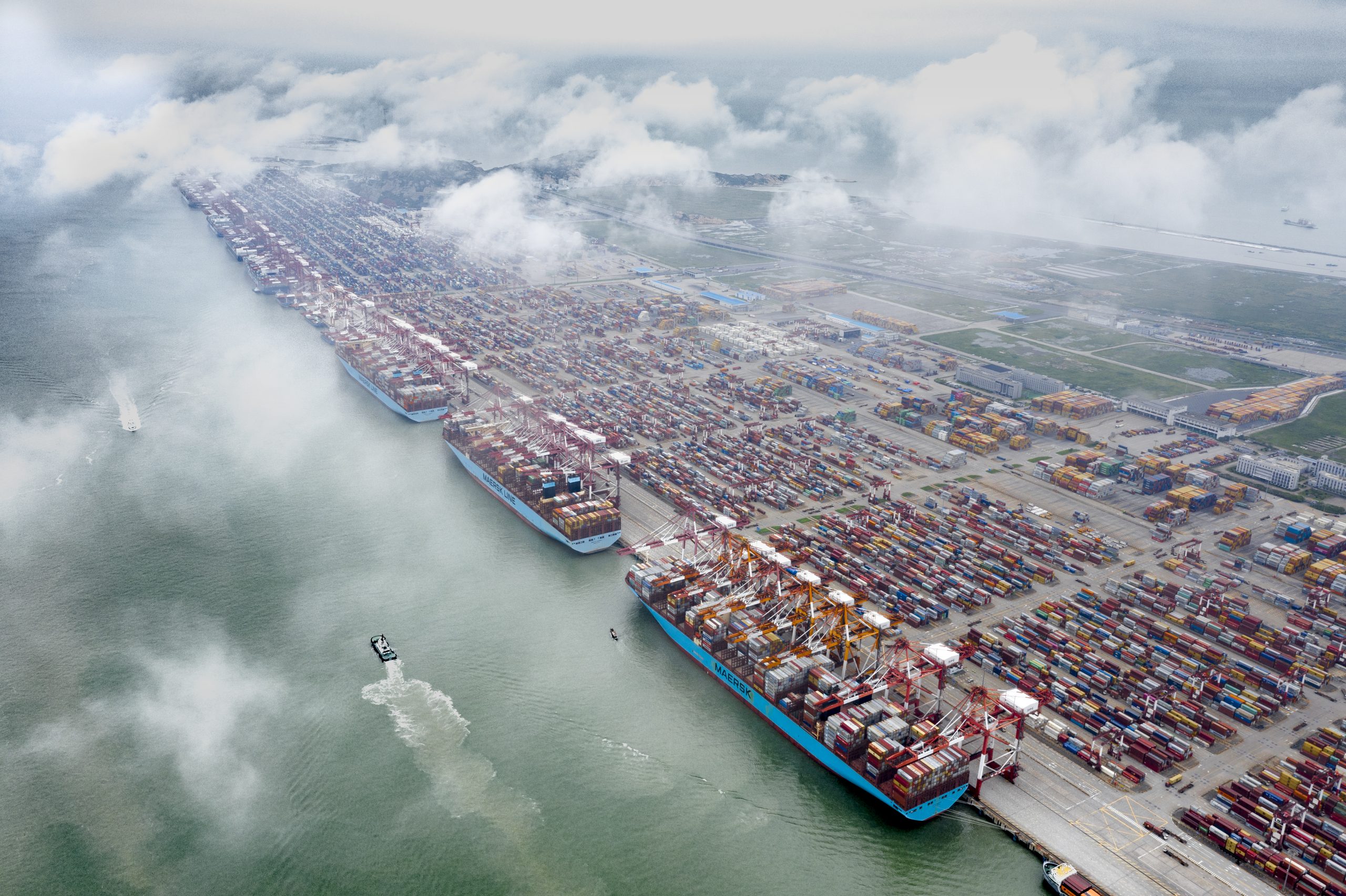
Three maersk container ships operate at the same time in Yangshan Port. Photo by Zhang Han
With the introduction of "two certificates and one yard" in Shanghai Port, Maersk’s truck-collecting highway transportation capacity in Shanghai and surrounding areas has been restored to 70%.
"At present, the transportation capacity of Maersk Truck Highway can basically cover the Yangtze River Delta region." Wu Bingqing told The Paper that due to the silent management of some drivers and yards, there are still some inland hinterland areas that can’t meet the capacity matching, and the inter-provincial long-distance transportation operation is still challenging. However, compared with the non-container transportation including van and LTL transportation, container transportation shows a positive recovery trend.
Although the customer’s supply chain is influenced by upstream suppliers and raw materials, the volume of Maersk air cargo is gradually recovering.
The Paper learned from Shanghai Airport Group that from May 1 to 14, Pudong Airport guaranteed 123 daily cargo flights, with an average daily cargo volume of over 5,500 tons, up by 42.41% and 72.88% respectively over the same period in April. As of May 13th, among the 34 Chinese and foreign all-cargo airlines operating in Pudong Airport, nearly half of them have recovered their capacity to over 80%, and one third of them have recovered their capacity to the range of 50% to 80%. More than 8,000 freight operators have implemented closed operations to fully guarantee the connectivity of Pudong Airport with core markets such as Europe, America and Asia-Pacific.
Land-to-water and sea-rail combined freight volume accounted for over 40%
"The biggest pain point for customers is how to complete closed-loop operations and the shortage of truck capacity." Wu Bingqing told the The Paper reporter.
Maersk launched a series of emergency plans when the freight transportation efficiency of local and neighboring provinces in Shanghai was affected. Among them, in order to ensure the operation of freight logistics, Maersk stepped up efforts to implement the services of "land to water" and "sea-rail combined transport" in early April.
"During this epidemic, the multimodal transport mode of land-to-water and rail transit has played a significant role as an alternative for Maersk to solve logistics challenges for customers." Wu Bingqing said that in early March, for example, the cargo volume of barge and sea-rail combined transport accounted for about 18%-20% of the total land-side transport cargo volume. During the one and a half months of epidemic prevention and control in Shanghai, the proportion of land-changed water and sea-rail combined transport increased significantly, reaching about 45%.
For example, Wu Bingqing said: "We provide long-term logistics services for a retail customer, including sea transportation and land transportation from Anji, Zhejiang to Shanghai Port. After the outbreak of the epidemic in Shanghai, prevention and control measures were tightened, trailer transportation was affected, customers had difficulty in shipping, and the supply chain encountered great challenges. The consignee’s inventory in foreign destination ports was in a hurry. "
In view of the actual situation of customers, Maersk Greater China logistics service product team quickly adjusted the multimodal transport solution, and 50 40-foot containers per week undertook ocean liner through barge service to ensure the continuous operation of customers’ supply chain.
Maersk’s "land-to-water" service has a short transportation time, usually 3 to 5 days. Compared with the traditional trailer service, it is less affected by the epidemic and there is no additional cost on the way. In addition, barges are docked with ocean-going ships at Waigaoqiao/Yangshan Wharf at least twice a week, and all docks in Shanghai Port maintained closed-loop operation and efficient operation during the epidemic period, which made the service highly stable. The barge directly connects with the dock, which can also reduce the time and communication cost in the transportation process.
According to reports, at present, Maersk’s "land to water" covers 12 docks along the Yangtze River from Taicang to Jiujiang, including Jiujiang, Nanjing, Wuhu, Yangzhou, Zhangjiagang, Taizhou, Changzhou, Wuxi, Anji, Dafeng, Taicang and Suzhou.
In addition, for long-distance transportation, Maersk makes the transportation capacity of enterprises more reliable and the supply chain more flexible through the sea-rail combined transport service.
Wu Bingqing said: "We have established long-term cooperation with leading global brands in machinery manufacturing, consumer electronics and home improvement industries, and our customers regularly export accessories and products from China to European and American markets. During the epidemic period, due to the impact of road transportation, the customer experience team of integrated logistics in Greater China responded quickly and formulated solutions. Chongqing, Suzhou, Hefei, Wuxi and Changzhou directly transported more than 300 40-foot containers to the dock by railway transportation, which enabled inland goods to be seamlessly connected to ocean liners and transported to Europe and the United States, meeting the supply needs of customers. "
Compared with the traditional trailer business, the sea-rail combined transport has more price advantages for the transportation distance of more than 500 kilometers, and the potential overdue storage fee and overdue container making fee can be avoided by picking up containers in the nearest yard. In addition, the trains are regular, and there are multiple trains connecting with the port schedule every week, which is not hindered by road restrictions, and can save 75% of the transportation time compared with barges. Maersk’s sea-rail combined transport also expanded to many areas during the epidemic, and now it covers almost the whole East China.
"During the epidemic, Maersk Shanghai office was closed, but all employees worked at home to provide uninterrupted services to customers. The company also launched an epidemic’ relief package’ for customers, helping customers to cope with the challenges of logistics supply chain by reducing and exempting a series of fees including demurrage fees, booking and consumption, power release fees, and third-place bill signing fees. We keep close communication with our customers to understand their shipping arrangements, so as to cope with the rebound of goods volume after Shanghai resumes normal production and life, and ensure the smooth supply chain and foreign trade, "added Wu Bingqing.