Zhang Weiping: Pursuing the Beauty of Mathematics (Telling and Promoting the Spirit of Scientists)
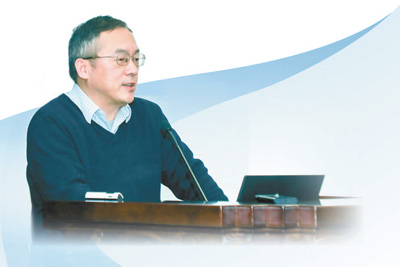
Zhang Weiping is giving a lecture. Photo by Zong Qiqi
Character business card
Zhang Weiping: Academician of China Academy of Sciences, born in Shanghai in March, 1964. Since 1988, he has been studying for doctoral students in Nankai Institute of Mathematics (later renamed Chen Shengshen Institute of Mathematics) of Nankai University. After receiving his doctorate in 1993, he has worked in Nankai University since then, and was elected as an academician of China Academy of Sciences in 2007. Zhang Weiping is mainly engaged in Atia in global differential geometry — Singer’s index theory and its application research have achieved a series of research results, and won the honors of "Top Ten Outstanding Young People in China", Chen Shengshen Mathematics Award, National Advanced Worker, and the Second Prize of National Natural Science Award.
"Many people say that I don’t look like a math student … …” Zhang Weiping told reporters with a smile. Indeed, Zhang Weiping, with a canvas bag, white shirt, trousers and casual shoes, is full of smiles and spirits, and talks wisely and humorously.
"Doing one’s best for China’s mathematics is the speech made by Mr. Chen Shengshen at the inaugural meeting of Nankai Institute of Mathematics in 1985, and it is also the principle he practices." The dialogue with Zhang Weiping began with his teacher and master of mathematics, Chen Shengshen. "It is Mr. Chen Shengshen’s long-cherished wish to build China into a powerful country in mathematics. For this goal, generations of algebra researchers have gone wave after wave. "
"Mathematics is a pure and beautiful knowledge, which is worth pursuing all your life."
In 1988, 24-year-old Zhang Weiping was admitted to Nankai Institute of Mathematics of Nankai University (later renamed Chen Shengshen Institute of Mathematics) and became a closed disciple of Chen Shengshen. In 1990, under the recommendation of Chen Shengshen, Zhang Weiping went abroad to study, and put forward the famous "Bismuth — Zhang Theorem ". During his study abroad, Zhang Weiping received a letter from Chen Shengshen, in which the sentence "Let China’s mathematics stand up" has been engraved in his heart … …
In 1993, Zhang Weiping got his doctorate and chose to return to Nankai University to start as a teaching assistant. "Patriotism should be one of the most important spiritual qualities of scientists." Zhang Weiping said. In November 2004, Chen Shengshen attended an activity in the field of mathematics, and he called on scientific researchers to be indifferent to fame and fortune and make selfless contributions to the country. Zhang Weiping has kept the recording of the teacher’s words to this day, so as to encourage himself, calm down and swim in the boundless sea of learning … …
According to Su Guangxiang, a professor at Chen Shengshen Institute of Mathematics, "Zhang Weiping has made so many achievements because of his perseverance and courage to explore mathematics research." For example, how to prove a famous theorem about positive scalar curvature on a lobular manifold by differential geometry has always been a great challenge to differential geometricians. Since 2000, Zhang Weiping has made a systematic study on the positive scalar curvature of lobular manifolds. In the course of his research, he tried various methods such as adiabatic limit and constantly revised his research ideas. After nearly 16 years of hard exploration, Zhang Weiping finally gave the differential geometry proof of this theorem, which was highly recognized by colleagues at home and abroad … … "Mathematics is a pure and beautiful learning, which is worth pursuing all your life." Zhang Weiping said.
"If you are doing something you like, continuous hard work is enjoyment."
Separated from Tianjin Central Line by a river, the provincial building of Nankai University is an independent corner, and there is a window that reveals lights almost every night … … This is Zhang Weiping’s office. For many years, Zhang Weiping stayed in the office day and night, immersed in the world of mathematics; On holidays, excitement has nothing to do with him. He often thinks quietly for a long time for a new idea … …
"Every day is Sunday for mathematicians", which is what Zhang Weiping used to say. He doesn’t mean that the work of an indexer is easy, but that every day dealing with mathematics is pleasant. Zhang Weiping’s calendar has never been divided into working days and rest days. He works in high spirits every day.
Chen Shengshen once said: "If a mathematician says that he has great intuition, don’t believe it, because the mathematical results are calculated step by step." Zhang Weiping also believes that the results come from long-term careful accumulation.
In 2004, Mr. Chen Shengshen passed away, and the baton of the director of the institute was handed over to Zhang Weiping, 40. "The responsibility is great, but it is incumbent on you, only you can work harder." With the development of the Institute, Zhang Weiping has added a lot of white hair to his temples. He was glad to see that the Institute kept moving forward: Professor You Jiangong was invited to give a 45-minute report at the 28th International Congress of Mathematicians, and Professor Tang Zizhou won the academy of sciences for the developing world Prize in Mathematics … …
"Difficulty, confusion and joy in the process of mathematical research and demonstration … … It’s a long story. If you are doing something you like, continuous hard work means enjoyment, not suffering. " Zhang Weiping knew that making China strong in mathematics needs the collective efforts of the mathematical circles in China. He actively participated in and organized various academic activities, supported other mathematicians to organize academic conferences, and invited experts and scholars to visit and give lectures … … He often cooperates with international mathematicians to build more bridges and ties for the development of mathematics in China. In 2014, Journal of Mathematics, an international mathematical magazine, published a paper on cooperation between Zhang Weiping and Professor Ma Xiaonan of the University of Paris VII. "We use the idea of analytic localization to solve the conjecture of geometric quantization in noncompact space put forward by a French mathematician in 2006. For this conjecture, the academic community has been studying it for 8 years and it is still inconclusive." Zhang Weiping said.
"I will study harder and cultivate more mathematics talents needed by the new era."
Teaching students in accordance with their aptitude, "one person, one policy", and determining different research topics according to the characteristics of different students; Give students a report on the basis of mathematics and advances in mathematics to stimulate students’ interest in mathematics; Instruct a number of graduate students and postdoctoral students, and lead students to continuously promote research with a solid style of study and rigorous attitude towards learning … … "It takes ten years to grow trees and a hundred years to nurture people. We should cultivate more and better talents for the country." Zhang Weiping has always attached great importance to the selection and training of talents.
A common sight in the institute is that students are in groups of three or five, discussing math topics. Every corridor has a blackboard, which is convenient for calculation at any time. "I never force students to do anything. As long as they love it, they will naturally study hard." Zhang Weiping said.
"That was my happiest day in Nankai." Many years after graduation, Han Fei, a student who works in a university in Singapore, still remembers a praise from his tutor Zhang Weiping: during his master’s degree study, Han Fei put forward an idea to Zhang Weiping, and the students worked on the blackboard while Zhang Weiping worked on the draft paper, which was meticulous and verified each other. When it comes to the bright future, teachers and students will smile at each other … …
Later, Han Fei graduated one year ahead of schedule, and his master’s thesis was awarded the "Zhong Jiaqing Mathematics Award Master Award" by chinese mathematical society; Han Fei also gave a new solution to a problem that has puzzled Zhang Weiping for more than ten years, which was published in the Journal of Differential Geometry.
Talking about the expectations of young people, Zhang Weiping said: "Mathematics is a basic subject, so we should pay more attention to it ‘ Useless ’ Use. As far as academic research is concerned, it is worthy of recognition to add icing on the cake on the basis of existing research results, but it is the most rare thing to really make original achievements. "
In Zhang Weiping’s view, the development momentum of domestic mathematics research is very good. "These young people have unlimited potential and represent the future of mathematics in China." Zhang Weiping said, "I will study harder and cultivate more mathematical talents needed in the new era."
■ Reporter’s Notes
Drive more people to love mathematics.
In an interview with a reporter, Academician Zhang Weiping, who knows the beauty of simplicity in mathematics, is tireless and clear-cut. For the great achievements made in personal academic research, he is low-key and modest. He is optimistic, firm and thoughtful about the construction of national mathematics discipline … … In his view, mathematics has never had anything to do with boredom, but a happy thing worth paying for all his life. In the face of difficulties and obstacles, he never stopped.
Zhang Weiping has always been aiming at the forefront of international mathematical research, and has been climbing scientific research peaks. Promoting the development of mathematics is not only the dream of his teacher, Mr. Chen Shengshen, but also his lifelong goal. Zhang Weiping said that he hoped to make more people fall in love with mathematics and expected more outstanding students to devote themselves to basic scientific research.
Nowadays, Zhang Weiping is studying the theory and application of Dirac operator, the most advanced mathematics operator, and continues to explore in the vast and profound fields, writing the legend of China mathematicians … …