[Perspective] American scholars criticized politicians for playing tricks to restrict teachers from teaching the history of slavery in class.
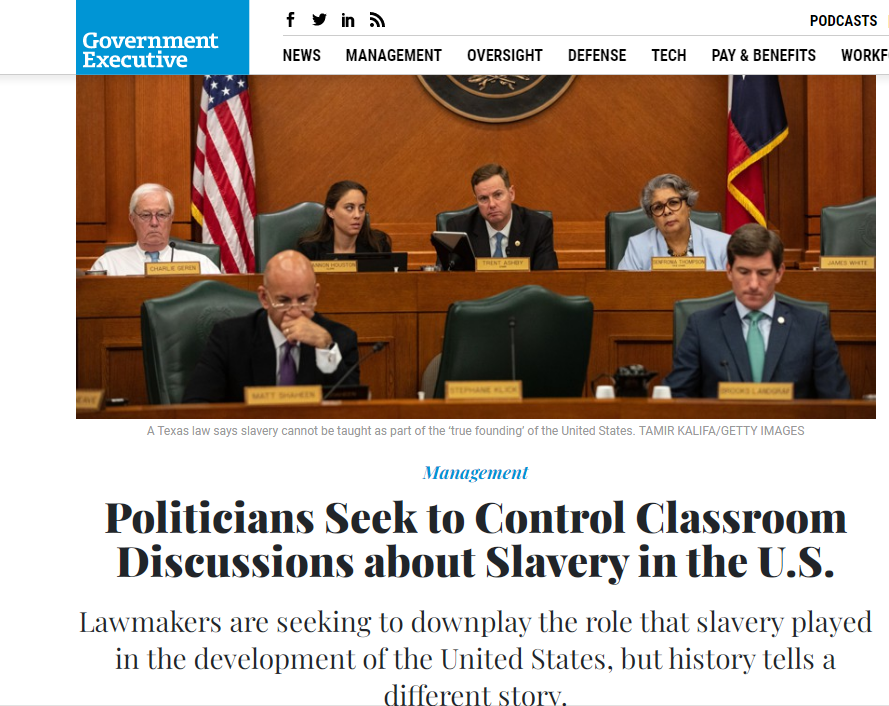
Screenshot of American Governance Magazine website
China Daily Online, August 17th (Dang Chaofeng) The website of American Governance Magazine recently published an article by Raphael E. Rogers, a professor at Clark University, denouncing that some American politicians have tried to restrict the discussion on the history of American slavery in the classroom by legislation over the past year or so. The following is a selection of articles:
Of all the subjects taught in American public schools, few have caused so much controversy as racism and slavery in the United States.
In the past year and a half, a large number of legislative bills proposed mainly by Republicans have attracted people’s attention. These bills, often called anti-critical racial theory legislation, are aimed at limiting the way teachers discuss race and racism in the classroom.
A more peculiar by-product of this legislation came from Texas. In June 2022, an advisory group of nine educators suggested that slavery be called "involuntary relocation". The idea finally failed.
As an educator who trains teachers how to educate young students about the history of slavery in the United States, I think the Texas proposal is part of a disturbing trend that politicians try to cover up the terrible and cruel nature of slavery and make it separate from the birth and development of the country.
Texas’s proposal stems from work done under Texas law, which stipulates that slavery and racism cannot be taught as part of the "real founding" of the United States.
In order to better understand the nature of slavery and its role in the development of the United States, it is helpful to grasp some basic facts, that is, how long slavery lasted in the United States and how many enslaved people it involved. I also believe in using real records to show students the reality of slavery.
Before "may flower"
Slavery in the United States usually dates back to 1619. According to the records of the colonist John Rolfe, at that time, a ship named "White Lion" sent more than 20 enslaved Africans to Virginia.
As for the statement that slavery is not part of the founding of the United States, the American Constitution itself is easy to refute. Specifically, article 1, paragraph 9, item 1 stipulates that before 1808, that is, within 20 years after the Constitution came into effect, Congress shall not legislate to prohibit the trade of imported slaves. In 1808, Congress finally passed the Slave Import Prohibition Act.
Although the bill imposed severe punishment on international traders, it did not end slavery itself or the domestic slave trade. Not only did it transfer trade underground, but also many illegally traded ships were brought into the United States, and their "passengers" were sold as slaves.
The last known slave ship "Clothilda" arrived in Mobile, Alabama in 1860, more than half a century after Congress banned the import of slaves.

source map
According to the transatlantic slave trade database from shipping records from 1525 to 1866, about 12.5 million enslaved Africans were transported to America. About 10.7 million people survived the "intermediate voyage" and arrived in North America, the Caribbean and South America. Among them, only 388,000 people arrived in North America.
Therefore, most enslaved people in the United States entered slavery not through import or "involuntary migration", but through birth.
From the first batch of more than 20 enslaved Africans arrived in the United States in 1619 to the abolition of slavery in 1865, about 10 million slaves lived in the United States and contributed 410 billion hours of labor. This is why from the founding of the People’s Republic of China to the Civil War, slavery was the "key cornerstone" to understand the American economy.
The value of historical records
I think it is valuable to use historical records to educate students about the harsh reality of slavery. I especially recommend three types of records.
1. Census records
Since every census from 1790 to 1860 counted the number of enslaved people, census records enabled students to learn a lot about who actually owned slaves. Census records also enable students to see the differences in slave ownership between States and across the country.
The census also showed that the slave population increased with time-from 697,624 in the first census shortly after the founding of the People’s Republic of China in 1790 to 3.95 million in the census in 1860, when the country was on the verge of civil war.
2. Advertisements for fugitive slaves
Few things can illustrate the horror and harm of slavery like the advertisements made by slave owners for runaway slaves.
It is not difficult to find that the escaped slaves described in the advertisement are covered with all kinds of beaten scars and traces of soldering irons.
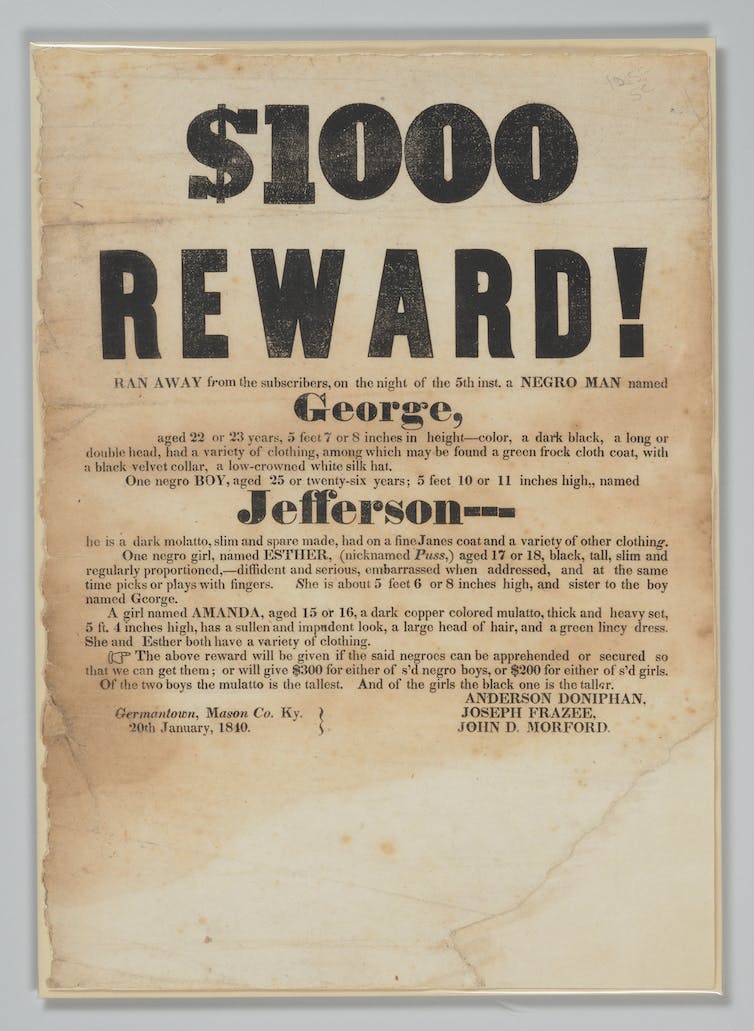
source map
On July 3, 1823, Daeghling, the slave owner, paid $25 to advertise in The Star and the North Carolina Gazette to find Ned, a fugitive slave. He described it as follows:
"About 21 years old, weighing about 150 kg, well-proportioned, full of energy, lively and lovely, looks fierce, a little yellow, and his front teeth are a little defective. I estimate that there are some traces of whipping on his hips and thighs, because he was whipped like this the day before he left."
Advertisements of fugitive slaves can be accessed through digital databases, such as Freedom in Action, which contains more than 32,000 advertisements. Another database, the North Carolina fugitive slave notice project, contains 5000 advertisements published in North Carolina newspapers from 1751 to 1865. The huge number of these advertisements reveals how many enslaved blacks are trying to escape from slavery.
3. Personal narrative of enslaved people
Although the number is small, there are still recordings of interviews with former slaves.
For various reasons, some of these interviews have problems. For example, some interviews are heavily edited by interviewees, or do not include complete and word-for-word interview transcripts.
However, these interviews still let us see the harshness of slavery.
Fountain Hughes was a slave. When asked whether he wanted to be free or enslaved, he told the interviewer:
"Do you know what I would rather do? If I were still a slave, I would take a gun and end it at once, because you are just a dog. You are nothing but a dog. You never have nothing to do for a night. Is it time to cut tobacco? If they want you to cut in the field all night, you have to. It doesn’t matter whether you are tired or not. You dare not say that you are tired. "
Ironically, when it comes to educating American students about the horror of American slavery and how it is deeply rooted in American political institutions, some politicians prefer to use restrictive laws to bind educators. What they can do is to let educators freely teach the role of slavery in the formation of a country, which is based on the principles of freedom and equality, as stipulated by the laws of Texas.