Research and Development of New Tools for "molecular machines" Compounds
Interpretation of the 2016 Nobel Prize in Chemistry
This year’s Nobel Prize in Chemistry seems to be a series of physics prizes. In order to explain the key achievement of the Nobel Prize in Chemistry more vividly — — Mechanical bonds that interlock cyclic molecules into chain or knot structures — — Once again, the Nobel Organizing Committee chose bread to illustrate the image. They took out two bagels and explained a pair of independent but connected molecules.
The Royal Swedish Academy of Sciences announced that it would award the 2016 Nobel Prize in Chemistry to three scientists, Jean-Pierre Sauvage, Fraser stoddart and Bernard Feringa, for their pioneering research in the field of "designing and synthesizing molecular machines", which started with mechanical bonds.
From mechanical bond to molecular chain
As early as 1950s, in order to create more advanced molecular structures, some chemists put forward the concept of mechanical bond.
Intermolecular interaction is generally a strong covalent bond formed by sharing electrons between atoms in different molecules, but cyclic molecules interact through mechanical bonds, and atoms do not interact directly, so the bonding force is more "loose", and two molecules can interact with each other, thus constructing the desired molecular machines.
In the first ten years after the mechanical bond was put forward, some scientific research teams synthesized molecular chains in the laboratory, which could not meet the practical needs. In the following years, the research in this field has been ineffective.
However, a great breakthrough in 1983 completely reversed the situation: Jean-Pierre Sauvage, director of the French Center for Scientific Research, led a team to interlock two molecular rings into molecular chains using ordinary copper ions, and the proportion of molecules forming molecular chains reached an astonishing 42%. Since then, molecular chains are no longer just legends, but step onto the ranks of functional chemistry.
Sauvage named the interlocking molecular chain of two cyclic molecules "Suohydrocarbon", and then he and stoddart developed molecular structures with cultural symbolic significance, such as trefoil knot, Boluo ring and Solomon knot. But these are just the foreshadowing. The protagonist of the 2016 Nobel Prize in Chemistry is molecular machines.
Molecular machines’s prophecy came true.
Regarding molecular machines, richard feynman, a famous Nobel Prize winner, once pointed out that in the future, we will use molecules to make machines with multiple moving parts. This machine is so small that it can only be seen with an electron microscope. "In the next 25 to 30 years, this molecular machines will be put into practical use, but I don’t know what machine will be used first."
Feynman’s prediction seems to have come true. Sauvage’s hydrocarbon structure made him successfully take the first important step in molecular machines’s research and development: the mechanical bond in the hydrocarbon allows two molecules to move relatively, which meets the basic conditions for the machine to perform tasks. In 1994, by applying energy, his team succeeded in making one of the hydrocarbons revolve around another ring in a certain way.
Stoddart developed a molecular structure called "rotaxane" in 1991, which was the second step of molecular machines’s research: stringing a molecular ring onto a molecular axis, and proved that the molecular ring can shuttle back and forth along the molecular axis like a weaving shuttle. After 1994, stoddart’s research team developed different molecular machines based on rotaxane, including molecular elevator that can raise 0.7 nm, molecular muscle that can bend an ultra-thin gold piece, and molecular chip that can store 20,000 bytes of data, which is expected to bring revolutionary changes to computer technology like silicon-based transistors.
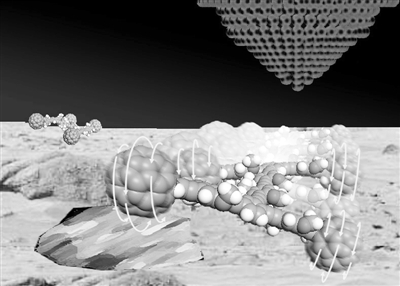
Since 1990s, many scientists have been competing to develop molecular motors, but Bernard Feringa became the first scientist to cross the finish line. In 1999, he developed the world’s first molecular motor, and successfully made the blades of a molecular motor continuously spiral in one direction through mechanical action. After continuous optimization, the speed of his molecular motor has reached 12 million revolutions per second in 2014. After that, Feringa’s team successfully designed a nano car with four molecular motors as wheels, which can move along the plane.
Create a new situation in chemical research
These molecular machines studies, which can win the Nobel Prize, have broken the embarrassing situation in the field of chemistry for many years. Molecular motors can be compared with those in the 1930s, and these molecular machines will be widely used in the research and development of new materials, sensors and energy storage systems.
First of all, the research and development in molecular machines can provide a toolbox for scientists all over the world who are developing more and more advanced compounds. For example, in 2013, scientists successfully developed a molecular robot based on rotaxane, which can grab amino acids and connect them to form a new protein structure.
Furthermore, scientists have successfully connected molecular motors with long-chain polymers. When exposed to sunlight, these motors will roll the polymers into messy bundles, and in this way, light energy will be stored in molecules, which is expected to develop a brand-new battery. The winding of motor and polymer will also shrink the material, so it can also be used to develop light-sensitive sensors.