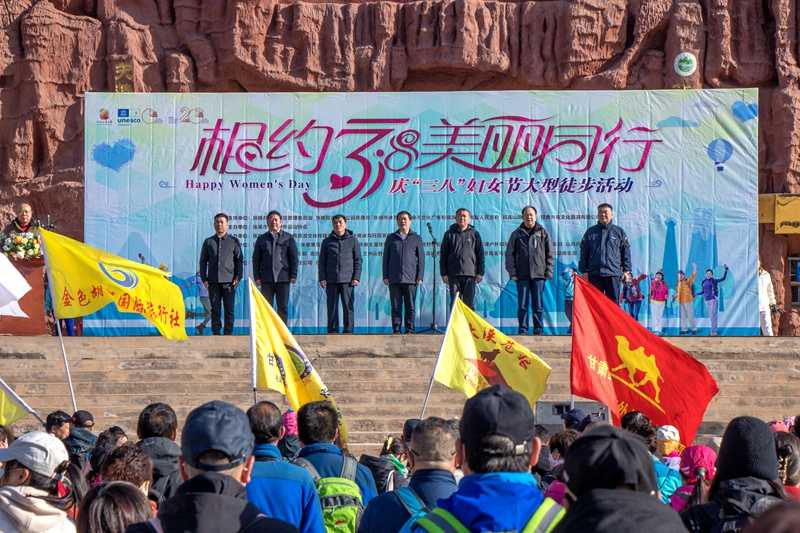
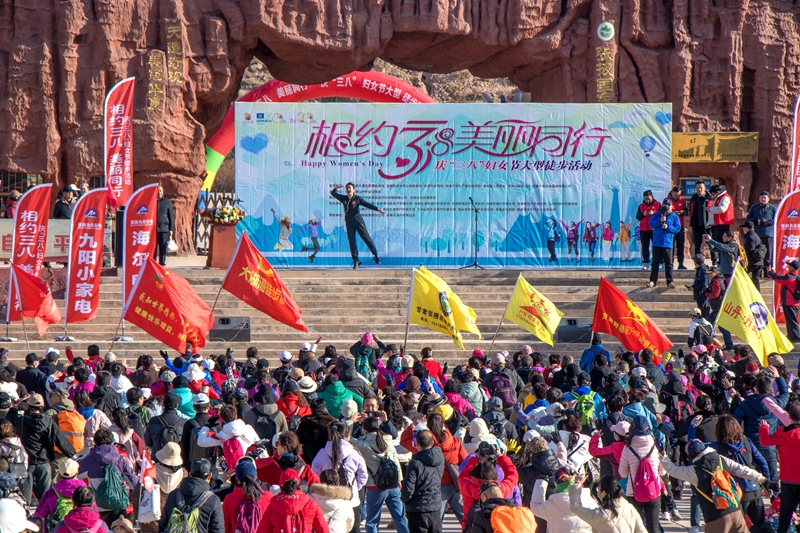
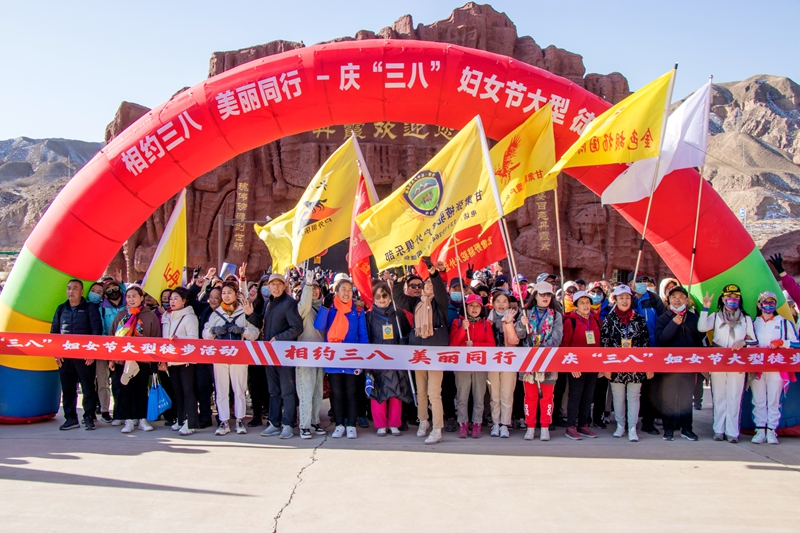
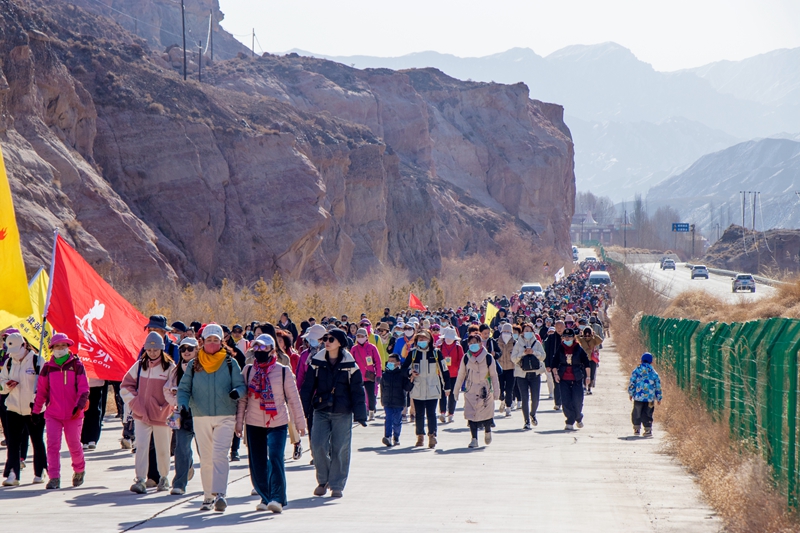
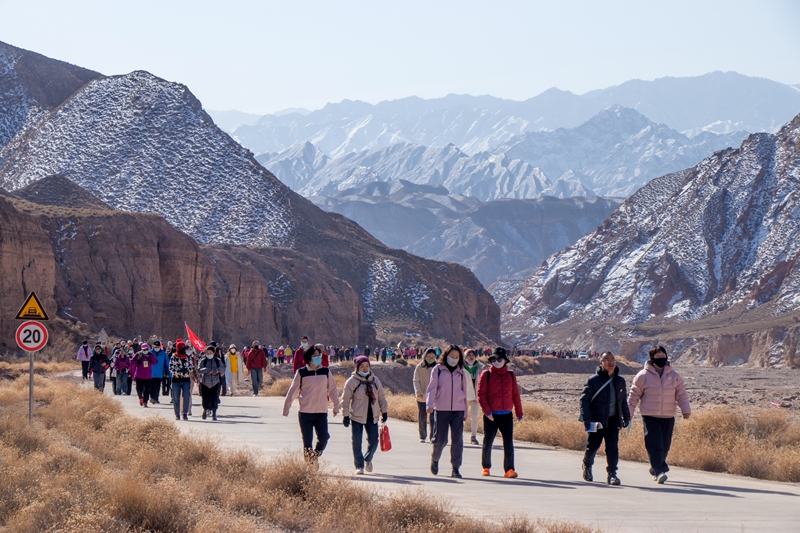
Zhangye City held a hiking activity to celebrate "March 8th" International Women’s Day.

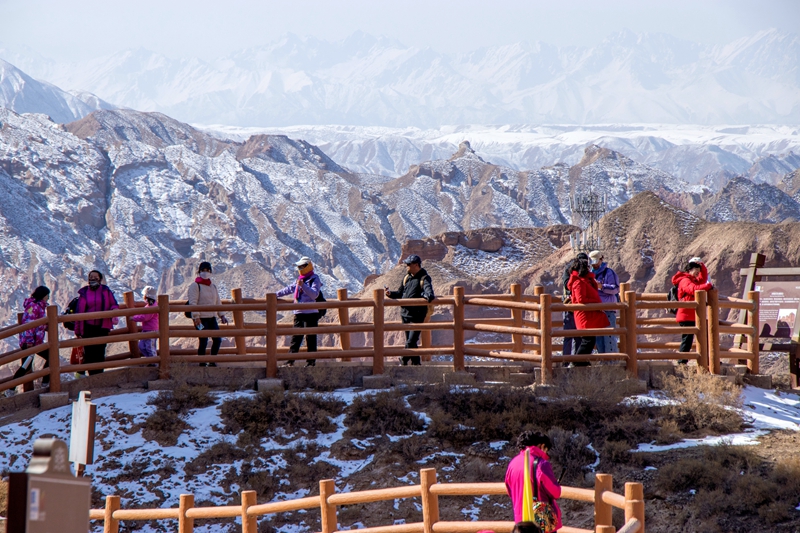
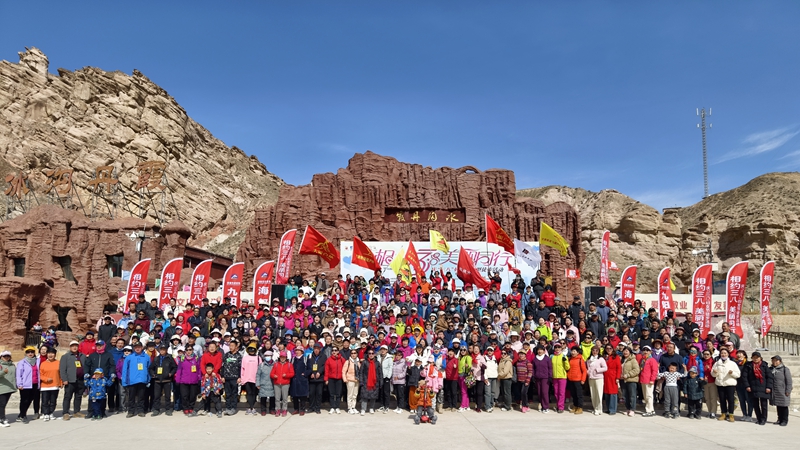
  China Zhangye Net News Recently, the March 8th International Women’s Day hiking activity was held in Zhangye National Geopark in 2024. More than 800 outdoor hiking enthusiasts and teenagers from Lanzhou, Jiuquan, Jiayuguan, Jinchang, Qinghai and other surrounding areas and local areas took a leisure walk, kept fit and celebrated the festival in the name of hiking fitness.


Chaoyang Shaoxia: Japan insists on accelerating the discharge of nuclear polluted water into the sea. What bad water is in its stomach?

  A 9.0-magnitude earthquake and a 9.3-meter-high tsunami caused the explosion of nuclear power plants and then the core melted down. In Fukushima, Japan on March 11th, 2011, three disasters occurred.
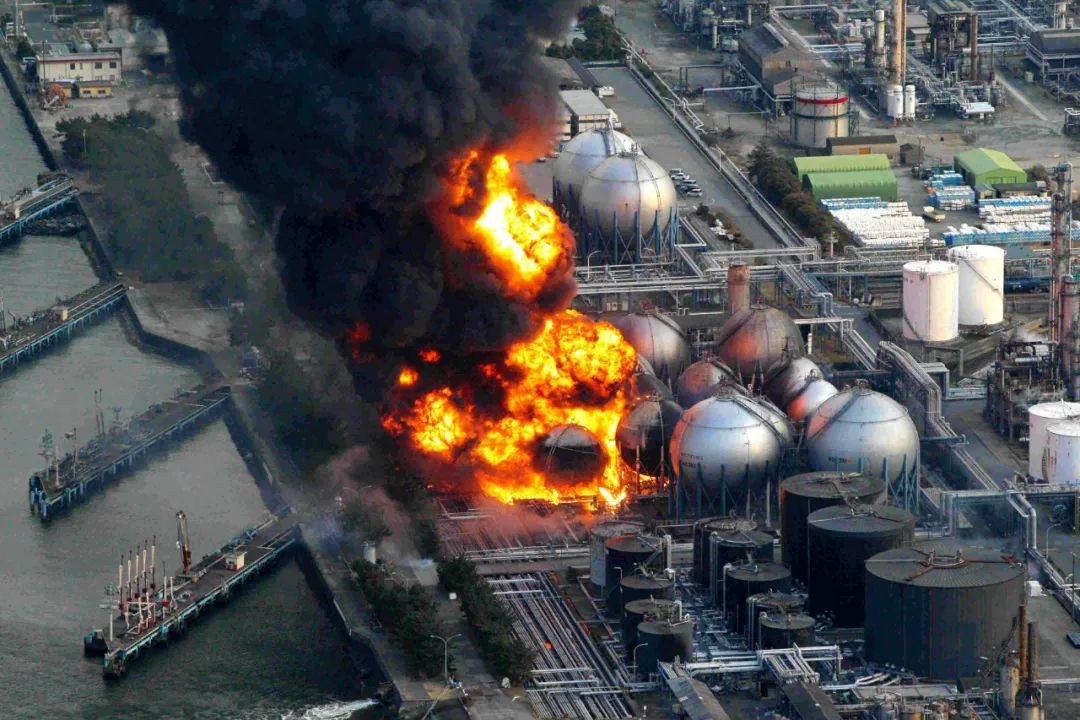
In March 2011, the earthquake triggered an explosion and fire at the Fukushima nuclear power plant in Japan.

  The fifth largest earthquake in history triggered the third major nuclear accident in history, resulting in catastrophic nuclear leakage. As early as April 2011, the Fukushima nuclear accident was designated as the highest level of nuclear accident, which was the same as the Chernobyl nuclear accident. In the past 12 years, the Fukushima nuclear accident has produced another 407,000 tons of radioactive waste. There are more than 700 tons of nuclear polluted water discharged into the sea in several large-scale leaks.

  Twelve years later, the reconstruction of the disaster area is still advancing at a high speed, while the nuclear polluted water is rising rapidly. At this juncture, the Japanese government has made a formal decision, but it is neither promoting post-disaster reconstruction nor accelerating the purification of polluted areas. Instead, it is necessary to pour nuclear polluted water into the Pacific Ocean and do it this year "in the spring and summer".

  So, what is the Fukushima nuclear polluted water? The Japanese government insists on discharging nuclear polluted water into the sea. What bad water is in its stomach?

  First, the water that exceeds the standard and exceeds the standard

  Fukushima nuclear pollution water mainly comes from nuclear accident cooling water and groundwater or rainwater polluted by radioactive substances, which is completely different from the wastewater generated by normal nuclear power plant operation. There is no precedent in the world to discharge such polluted water into the sea in large quantities. At present, the total amount of nuclear polluted water in Fukushima has reached 1.37 million tons, which is equivalent to more than 700 standard swimming pools filled with water. And this is just the tip of the iceberg. At present, the nuclear polluted water is still increasing at a rate of more than 100 tons per day, and the scrapping process of nuclear power plants is expected to take more than 30 years.

  In view of the key steps in handling nuclear accidents — — The delay in taking out the molten residue from the core means that more and more polluted nuclear polluted water will be continuously produced in the future, which will be rapidly eroded by the active ocean current "Kuroshio" along the Fukushima coast.
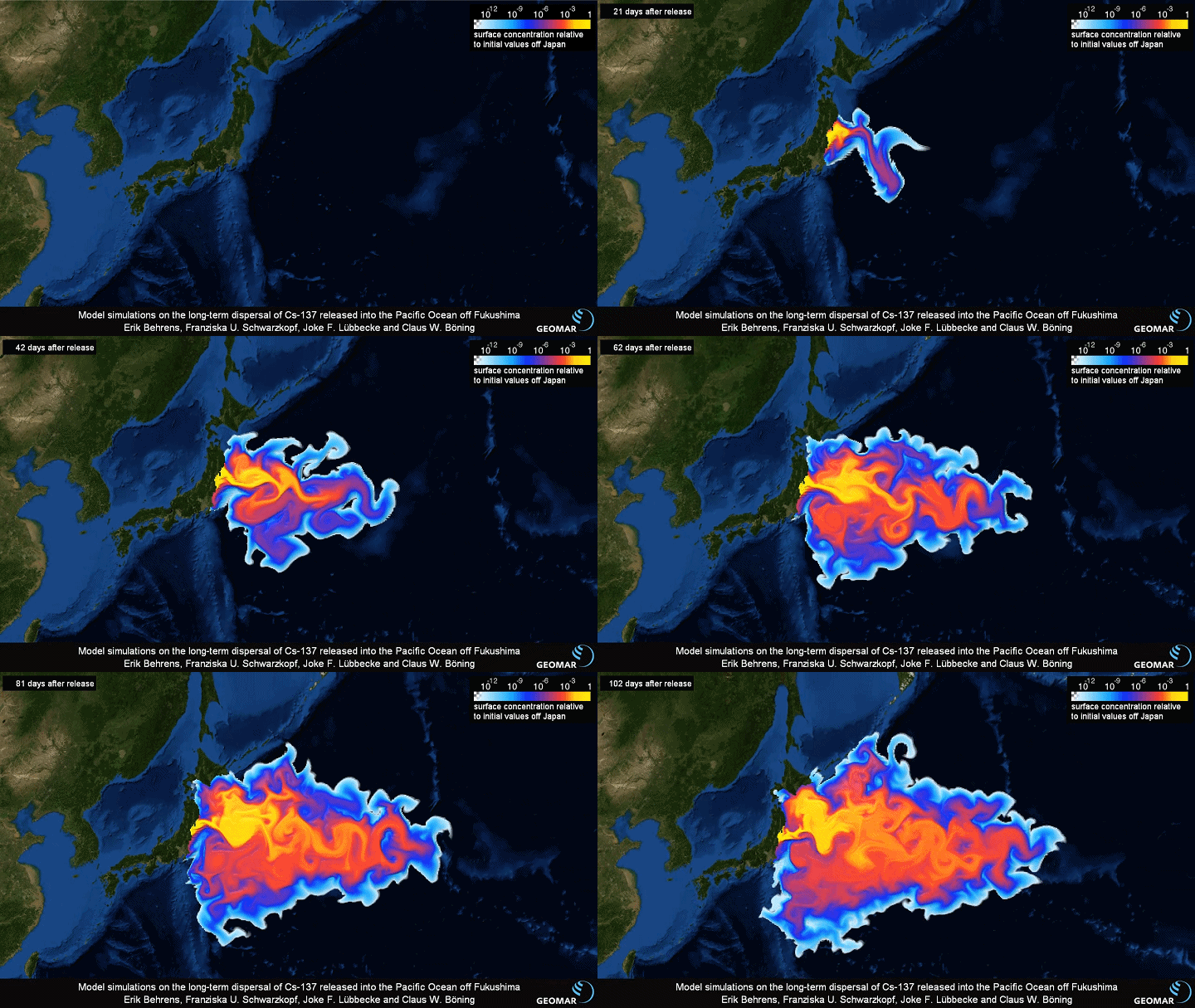
Simulation effect diagram of German marine scientific research on diffusion speed and influence of nuclear polluted water. As can be seen from the figure, radioactive substances will continue to spread over time, and then spread to the global waters. (Source | GEOMAR)

  Different from the wastewater discharged from normal nuclear power plants, the nuclear polluted water in Fukushima, Japan contains more than 60 kinds of radioactive substances. Japan’s processing technology can’t remove radioactive tritium. After practical operation, it was found that even strontium -90 and carbon -14 could not be treated, and the half-lives of these two radionuclides were 50 years and 5730 years respectively.

  Tritium will replace hydrogen atoms in the human body, forming long-term radiation in the human body, causing chronic radiation sickness and even cancer. Strontium -90 is highly toxic and can cause tumors in bones and surrounding tissues. The half-life of carbon -14 for thousands of years makes it easy to be enriched in the food chain, causing damage to the DNA of the ingester.

  According to expert analysis, there are many abnormal and suspicious measured values in the nuclear polluted water detection data of Tokyo Electric Power Company (Fukushima nuclear power plant operation manager, referred to as TEPCO), which cannot be the basis for determining emissions. TEPCO also admitted that 73% of the treated nuclear polluted water still did not meet the discharge standards. In addition, the nuclear pollution water treatment system has frequent failures, and in 2021 alone, the filter was damaged twice on a large scale.

  Japan wants technology, land and land. It can treat nuclear polluted water or expand water storage facilities through technical means, but it chooses to pour nuclear polluted water into the Pacific Ocean. To put it bluntly, it is selfish and irresponsible to avoid difficulties, spend less money and get rid of burdens, so that the whole world can pay for Japan.

In October 2019, after a typhoon, garbage bags containing radioactive nuclear waste were found in the suburbs of Fukushima Prefecture.

    Second, the water of lazy politics

  Once upon a time, honesty, preciseness and diligence were the labels that the Japanese labeled themselves. Let’s see if this label is genuine.

  Fake nature. The history of fraud in TEPCO can be traced back to 1977, and the test data of nuclear facilities have been tampered with more than 200 times, even after the nuclear accident, it still went its own way. In 2021, the matter of concealing the damage of the filter screen of the sewage processor has not stopped. In October 2022, TEPCO was exposed to "prove" the safety of nuclear polluted water to visitors with a "tricky" radiation detector, which made misleading propaganda for large-scale sea discharge.

  All these things, is it true that the Japanese government tampered with the history of aggression? Or was it inspired by the Japanese government? Who can believe the data disclosed by TEPCO? Can the nuclear polluted water discharged into the sea really reach the standard?

  Man-made disasters happen. If the Fukushima earthquake and tsunami are natural disasters and force majeure, then the Fukushima nuclear accident is a man-made disaster and a tragic human tragedy.

  According to the report of the Japanese parliamentary investigation committee, the Fukushima nuclear accident is "not a natural disaster, but obviously a man-made disaster". The Fukushima nuclear power plant was in a state of being hard to resist the earthquake or tsunami, but it never made countermeasures in advance. After the nuclear accident, the Japanese central government’s command system was chaotic, and the crisis management system failed to play its role effectively, which led to the escalating crisis.

  In the post-disaster disposal stage, due to the inaction of the Japanese government and TEPCO, the nuclear polluted water of Fukushima nuclear power plant has leaked many times. In August 2013, at least 300 tons of nuclear polluted water flowed into the sea, which was classified as a Class III international nuclear accident, causing a "major abnormal situation", but the Japanese investigation result was a light sentence of "screw loosening".

The residents of Langjiang Town in Fukushima Prefecture were all evacuated after the Fukushima nuclear accident. Until the relevant restrictions were lifted in 2017, the population of Langjiang Town was zero.

  Poor disaster relief. "Fukushima nuclear accident victims" once exceeded 160,000, and nearly 40,000 people have left their homes today.

  The revival minister in charge of dealing with nuclear accidents has changed 12 times. The first minister resigned after nine days in office for intimidating journalists. Some are suspected of political problems, some are exposed to a scandal, and some actually claim that fortunately, the disaster happened outside the metropolitan area, and it is a "personal responsibility" for some victims to be unable to go home so far.

  In the 12 years after the disaster, the nuclear pollution in Fukushima was intractable, and tens of thousands of victims were displaced. However, the most impressive impression given by the minister of rehabilitation turned out to be all kinds of ugliness.

In July, 2011, Ryu Matsumoto, the first Japanese minister of revival, resigned after nine days in office for making inappropriate remarks.

  Third, the water of injustice

  The Japanese government insists that Fukushima nuclear pollution has reached the discharge standard after water treatment, but why is it strongly opposed in Japan?

  Affected by nuclear radiation, many mountain ponds in Fukushima have been abandoned for a long time, and radioactive substances such as natural mountain vegetables and mushrooms have exceeded the standard. The catch of the three major fisheries associations in Fukushima in 2022 was more than 5,500 tons, but it was 20% before the Fukushima nuclear accident.

  In Japan, the voice of opposing the sea discharge is higher and higher. Miyagi Prefecture Governor Kazuo Murai asked the Japanese government and Tokyo Electric Power Company to study alternative methods. National and disaster-stricken fishery organizations have repeatedly voiced their voices. Civil society organizations have submitted hundreds of thousands of joint signatures to the Japanese government and TEPCO. People gathered in the streets of Tokyo, Osaka, Shizuoka and other places to oppose the sea discharge and demanded that the Japanese government revoke its decision. Some demonstrators made slogans such as "the ocean is crying, the fish is crying, and the earth is crying".

  In the face of surging public opinion, the Japanese government basically ignored it except for holding several symbolic hearings. The revival of the disaster area is far away, and the decision to expel the sea is tantamount to adding insult to injury. Once implemented, it will completely destroy the hopes of those victims who are struggling to survive.

In April, 2021, a protester held a cartoon outside the Prime Minister’s residence in Tokyo, Japan, against the Fukushima nuclear polluted water discharging into the sea.

  The Japanese government insists that the discharge of Fukushima nuclear polluted water into the sea will not affect the global marine environment and human beings, but why is it widely questioned by the international community?

  Marine and ecological experts pointed out sharply that after the Fukushima nuclear polluted water is discharged into the sea, it will quickly spread to most areas of the Pacific Ocean, thus affecting the global waters. Radiation will be absorbed by marine organisms and enriched into human body along the food chain, which is a great threat to Pacific Rim countries and the ecosystem on which all mankind depends.

  South Korea requires Japan to provide transparent and safe information in time and take responsible measures. Pune, Secretary-General of the Pacific Islands Forum, said that Japan should not start discharging the sea until relevant parties confirm the safety of the emission scheme. The EU requires Japan to fully fulfill its national and international obligations to ensure the absolute safety of any emissions.

  The United Nations Human Rights Council issued a report urging the Japanese government to face up to its responsibility in the treatment of nuclear pollution. United Nations human rights experts issued a joint statement saying that Japan’s decision to discharge nuclear polluted water into the sea was "deeply disappointing" and "very worrying".

  In February 2022, China and Russia issued a joint statement, expressing serious concern about the discharge of Fukushima nuclear polluted water into the sea, stressing that Japan must fully consult with stakeholders such as neighboring countries and relevant international institutions, and properly dispose of it in a responsible manner on the basis of openness, transparency, scientific argumentation and compliance with international law.

  After the Fukushima nuclear accident, China, Russia, South Korea, etc. helped Japan immediately. However, Japan bite the hand that feeds it back, ignoring the life, health and safety of the international community and people in neighboring countries, stealing and forcibly discharging nuclear polluted water. There is nothing like this at the expense of others.
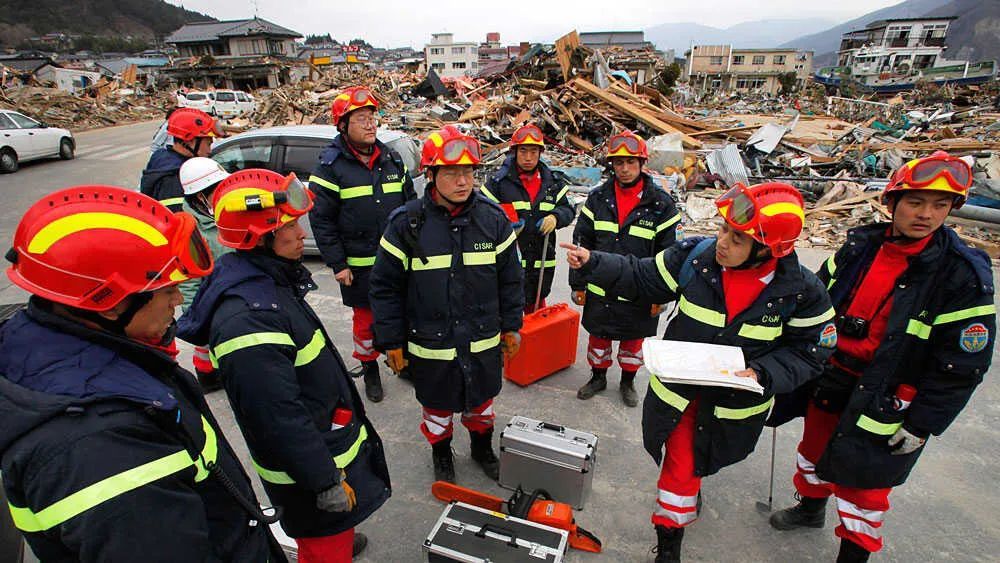
In March 2011, the first time after the Fukushima nuclear accident, the Chinese rescue team went to the disaster-stricken areas in Japan to provide assistance.

  The Japanese government insists that the issue of Fukushima nuclear polluted water discharged into the sea is under the supervision of the international community, but why did it make a claim before the International Atomic Energy Agency (IAEA) completed its supervision and review?

  On January 20, 2023, the IAEA working group ended its review of the regulatory issues related to the discharge of nuclear polluted water in Fukushima, and an assessment report will be released around April at the latest. However, as early as January 13, before the working group set out, the Japanese government unilaterally announced that it would discharge the sea in "spring and summer". This is obviously a slap in the face to the IAEA, and the implication is that you judge you and I rank mine.

Storage tank for storing nuclear polluted water in Fukushima nuclear power plant, Japan.

  In addition to ignoring international institutions, violating international laws and rules and fooling the international community, Japan has done a lot: the principle of prudential obligation applicable to the discharge of nuclear wastewater into the sea in international law requires that Japan should exhaust all means to prevent, reduce and control marine pollution, while Japan insists on discharging nuclear polluted water into the sea while it can continue to build water storage tanks; The principle of international cooperation requires that Japan should fully cooperate with neighboring countries and the international community, but Japan did not get the understanding of neighboring countries before announcing its decision to expel the sea. The principle of risk prevention requires that Japan should take the initiative to take preventive measures on the harm of nuclear polluted water, but Japan has always refused to take measures under various excuses.

  Fourth, water under the bridge

  The Pacific Ocean is the common property of all mankind, not a sewer in Japan, nor a dumping pond for nuclear polluted water. Once the Fukushima nuclear polluted water is discharged into the sea, it may lead to irreparable and profound disasters, and the whole world will suffer. What Japan discharges is nuclear polluted water, and what it discharges is its own conscience.

  Three questions to the Japanese government:

  One question: where is integrity? Japan has advocated "faith is everything" since ancient times. In dealing with the problem of nuclear polluted water, the Japanese government once solemnly promised to the victims that "no disposal will be carried out without the understanding of the relevant parties". Does the so-called "universal value" boasted by Japan not include honesty? How much darkness and filth is hidden under the humble body?

Many groups and people from many countries in Japan have publicly voiced their voices, criticizing the Japanese government for breaking its promise and expressing strong opposition to the decision to expel the sea.

  Second question: where is the axiom? Japan always pretends to be a country that attaches importance to "democracy" and "human rights". In the face of 40,000 victims leaving their homes, strong opposition from all walks of life in China, widespread criticism from the international community, and questioning and warning from academic circles at home and abroad, the Japanese government played a deaf ear and acted recklessly. Is this what a self-proclaimed "democratic country" did? Whose rights does this protect? What does Japan regard science as? Where should we put the global marine ecological security and environmental security, and the people’s right to health and survival in all countries?

  Three questions: where is the rule of law? Japan often advocates a "rules-based international order" in high profile, but what it actually does often ignores rules and ignores the rule of law. Isn’t it Japan that fools and prevaricates international institutions? Isn’t it Japan that unilaterally changed the status quo in the Pacific? Isn’t it Japan that violates the United Nations Convention on the Law of the Sea, the Convention on Early Notification of a Nuclear Accident and the Convention on Nuclear Safety?

The Japanese government and TEPCO once made a promise that they would not dispose of the nuclear polluted water without the understanding of relevant parties, but now they go their own way in violation of their promises, ignoring the legitimate concerns and strong voices of the domestic people and the international community and forcing the nuclear polluted water to be discharged into the sea. (Comic | Liu Rui)

  Some people say that Japan’s discharge of Fukushima nuclear polluted water into the sea has been approved by the American big brother. I want to say that when Japan kneels down on the United States, it can’t be independent, it can’t be healthy and peaceful, and it can’t get good fruit to eat.

  A Japan that falsifies the history of aggression, destroys the international order, and harms the homeland of mankind will never stand erect and become a "normal country".

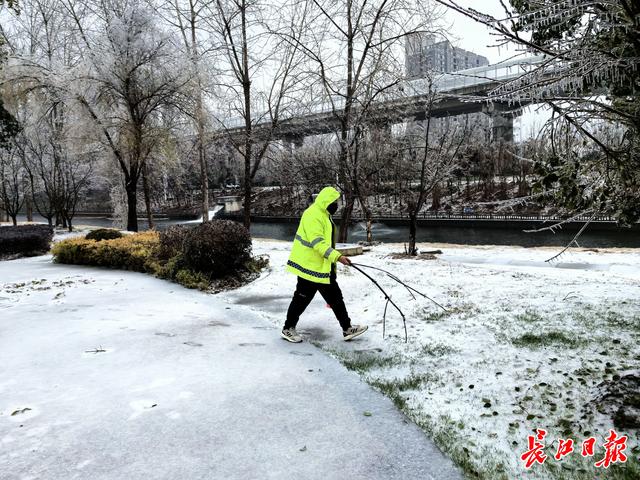
The snowy road is frozen, so please pay attention to safety when traveling.

On February 3, 2024, the first heavy snow fell in Wuhan. Due to the cold weather, many roads are frozen and trees are frozen. The reporter saw in the vicinity of Machi Road, gold and silver lake Street, Dongxihu that some branches were bent and prostrated, and garden workers were cleaning up the fallen trees. Relevant departments are taking measures to actively deal with freezing rain and snow. Our reporter warmly reminds readers that in rainy and snowy weather, pay attention to icy roads and slippery roads.
(Changjiang Daily reporter Jin Zhenqiang photo report)
[Editor: sugar man]
For more exciting information, please download the "Great Wuhan" client in the application market. Please don’t reprint it without authorization. Welcome to provide news clues and pay them as soon as they are adopted. 24-hour reporting hotline: 027-5922222.The copyright of this article belongs to the original author. If it comes from the wrong source or infringes on your legitimate rights and interests, you can contact us through email, and we will deal with it in time. E-mail address: kin0207@126.com
Reporting/feedback

Boom! Bang! God!

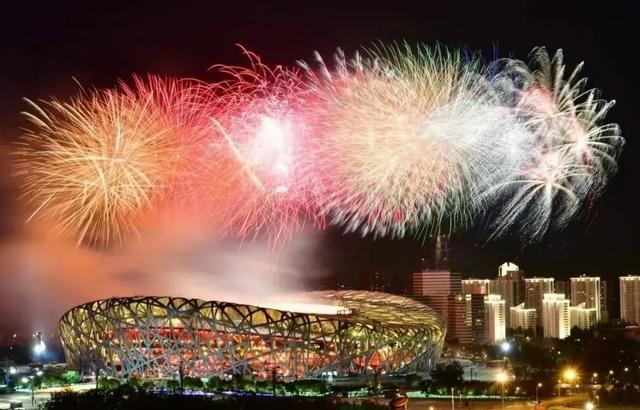
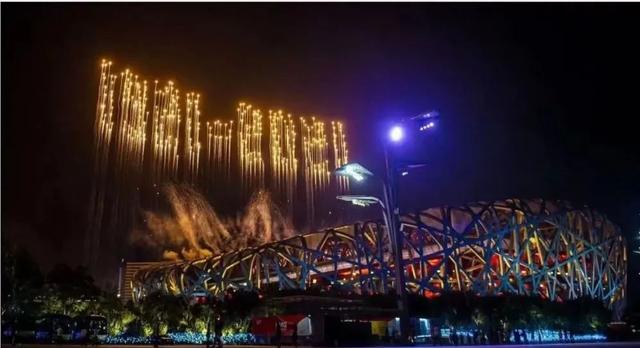
The fireworks set off in the Bird’s Nest the other night must have surprised you in front of the screen. What, you didn’t see it? Don’t panic! This will take you back to the fireworks you missed.
1. The origin and history of fireworks
Fireworks, also known as fireworks, fireworks, firecrackers, fireworks and so on, originated from gunpowder, one of the four great inventions in ancient China. The exact time when fireworks were produced is not available, but Emperor Yangdi of Sui Dynasty wrote a poem "Lights shine on trees, and seven flowers bloom" ("Poem on Building Lights in the thoroughfare on the 15th day of the first month and Rising to the South Tower at night"), which tells the scene of setting off fireworks (that is, fireworks) during the Lantern Festival. This shows that at least in the Sui and Tang Dynasties, there was a rudiment of fireworks used to celebrate festivals and entertain people.
The "shelf fireworks" or "bonsai fireworks" in the Song Dynasty have reached a considerable scale. Xin Qiji, the representative of the unrestrained poet, once wrote the words "Thousands of trees bloom in the east wind night, and the stars are like rain" ("Jade Case, Yuanxi"), which is a vivid and vivid description of it.
During the Yuan and next years, many poets and writers have written accounts of firecrackers and fireworks. For example, Zhao Meng’s poem "Giving Fireworks" in the Yuan Dynasty "is as brilliant as stars and as loud as fire." It describes the lively scene of setting off fireworks on the fifteenth day of the first month, comparing fireworks to meteors and fire attacks.
With the continuous improvement of the production technology and scale of fireworks in the Qing Dynasty, fireworks not only appeared in palaces and the residences of dignitaries, but also became a habit for people to set off fireworks during festivals. In order to strengthen the management of fireworks, the Qing Dynasty’s "Laws of the Qing Dynasty" stipulates that all fireworks workshops must be approved by the government before they can be listed, and fireworks must be set off in specified places.
2. Why can fireworks explode?
After understanding the history of fireworks, what is it? Xiaobian, this will take you to understand.
Fireworks,It is an object made of gunpowder and metal powder, which will burn, explode and bloom with colorful light after being ignited by fire, and is usually used outdoors.
black powder
The principle of fireworks is similar to that of firecrackers, and its structure includesblack powderandYaoyin(fuse) Black powder is what we often call "one sulfur, two nitrates and three charcoal":
S + 2KNO3+ 3C = K2S + N2↑+ 3CO2↑
The condition of the above reaction is ignition, and sulfur and potassium nitrate are oxidants.
Sulfur,It is a light yellow brittle crystal or powder with a special odor. It is a flammable solid, which can be made from natural sulfur ore or pyrite, carbon and oxygen at high temperature.
sulphur
potassium nitrateIt can be extracted from nitrate soil. The main principle is to use potassium ions in plant ash to replace sodium ions in nitrate soil, thus generating potassium nitrate. Contact with organic matter can cause combustion and explosion.
potassium nitrate
charcoalIt is the dark brown or black porous solid fuel left by incomplete combustion of wood or wood raw materials or pyrolysis under the condition of air isolation.
charcoal
A heat source is provided externally to ignite the fuel. The oxygen released by the decomposition of potassium nitrate makes charcoal and sulfur burn violently, producing a lot of heat, nitrogen, carbon dioxide and other gases instantly. The chemical reaction caused the explosion, and most of the energy released during the explosion was converted into light and appeared in our eyes.
3. How do fireworks?
HeavenAnd produce different colors?
Fireworks are generally sealed, and after the explosion reaction, a lot of heat and gas will be generated. In a closed environment, due to the poor sealing of the upper and lower ends, gas will be ejected from below. According to Newton’s third law, the fireworks get upward power, and the internal energy of gunpowder is converted into heat energy, kinetic energy and potential energy of the fireworks. When the gunpowder is exhausted, the fireworks bomb continues to rise due to inertia, and at this time, the internal explosives are ignited and explode in the sky.
Internal structure of fireworks
In the process of making fireworks, some luminescent agents and chromophores are usually added to make fireworks emit colorful colors. Both the luminous machine and the chromogenic agent contain metal compounds, and different kinds of metal compounds will emit different colors of light when burning. This is what we often say.flame reaction.
Flame reaction color of common metals
Xiaobian reminds everyone to pay attention, flame reaction isphysical changeDon’t remember wrong.natureEvery element has its own unique spectrum. When heated, atoms’ electrons will absorb energy and jump to a higher unstable energy level, and then return to the previous low energy level and release electromagnetic waves with a specific wavelength. The electromagnetic waves released by some metals are just in the visible light band, and we see colorful colors.
A colorful fireworks display at a party
4. Xiaobian has something to say
Presumably, now that you have a better understanding of fireworks, you can tell (chui) to (xu) other people (bo) the next time you watch fireworks. Fireworks have a history of thousands of years in China, and it has long been our habit to set off fireworks on holidays. Everyone should abide by relevant regulations and pay attention to safety when setting off fireworks ~
Finally, let’s enjoy the beautiful fireworks again ~
Note: The pictures in the article come from Baidu, Weibo and other networks; If there is any infringement, please contact to delete it.
Source: Institute of Semiconductors, Chinese Academy of Sciences
Editor: dogcraft
Reporting/feedback

Kavan Automobile, a brand new energy commercial vehicle brand of BAIC Group, was officially released.

On January 27th, Calvin Automobile, a brand new energy commercial vehicle brand under BAIC Group, was officially released. In the future, Calvin Automobile will launch brand-new platform products around the two major technical routes of pure electricity and hydrogen fuel cells, accelerate the transformation of Beiqi Futian into new energy, and help the construction of the Capital Science and Technology Innovation Center.

Nearly 500 people including Zhi Xianwei, deputy secretary of Changping District Committee, Su Guobin, deputy director of Beijing Economic and Information Bureau, and Jiang Zili and Chang Rui, leaders of BAIC Group, attended the conference.

New positioning, activation and development of new kinetic energy

In recent years, BAIC Group has been based on the construction of the "four centers" in the capital, integrated into the "five-child linkage" development pattern, adhered to science and technology-driven development, and continuously promoted the top-level strategic deployment in the field of new energy. The "BLUE Plan" released in 2022 shows that BAIC will further promote comprehensive new energy utilization and intelligent networking, build a full range of green and low-carbon products for passenger cars and commercial vehicles, and fully realize peak carbon dioxide emissions in 2025, and fully decarbonize products and operate carbon neutrality in 2050.

At present, BAIC Group is accelerating the pace of comprehensive new energy strategy, based on the new energy technology innovation of "pure electricity+hybrid", promoting the new energy strategy to land in the whole value chain of technology, products and supply chain, and the genealogy of new energy products is gradually clear in the rapid adjustment of product structure. Among them, in the field of passenger cars, supported by two brands, Extreme Fox and Beijing, a new energy-based product system of BAIC’s own brand passenger cars is composed of pure electric power and hybrid power. In the field of commercial vehicles, Beiqi Foton has formed a full product matrix of commercial vehicles covering all technical routes of pure electricity, hybrid and hydrogen fuel, covering the whole scene.

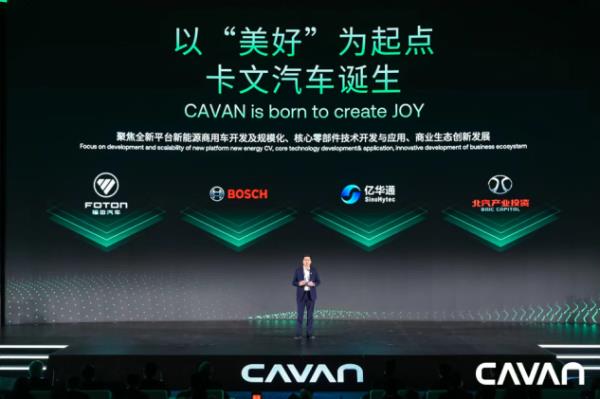
In this context, Beiqi Foton has made clear that the new energy strategy is the first strategy for the company’s development. In 2022, BAIC Foton and Bosch, Yihuatong, BAIC Investment Co., Ltd. jointly invested and established Calvin Automobile, focusing on a brand-new pure electric and hydrogen fuel platform, positioning to create a low-carbon and zero-carbon industrial ecology, deeply cultivating the global zero-carbon heavy truck, and committed to becoming a unicorn enterprise in the field of new energy vehicles around the world. In the future, Calvin Automobile will introduce more high-quality industrial chain partners as investors, and promote the healthy development of the company through the asset-light strategy way with a more flexible shareholding structure.

At the press conference, Zhi Xianwei, Su Guobin, academicians of China Academy of Engineering, professors of Beijing Institute of Technology, Sun Fengchun, Tsinghua University and Zhang Xiliang, members of the National Committee of Experts on Climate Change, delivered speeches on the development of new energy automobile industry and the development trend of the industry at Beijing and district levels, respectively, and made suggestions on the development of Kawen automobile. Jiang Zili, deputy secretary of the Party Committee of BAIC Group, said that the development of Calvin Automobile will play an important role in supporting and promoting BAIC to implement the "double carbon" strategy and realize the transformation and upgrading of the commercial vehicle sector. The Group will fully support the development of BAIC Foton and Calvin Automobile in the field of new energy commercial vehicles.

Brand new and build a green ecosystem

After the establishment of Calvin Automobile, the company’s headquarters was settled in the Future Science City of Changping District. Over the past year or so, Calvin Automobile has introduced a large number of talents to build a new system around the technology, products, supply chain and brand of new energy commercial vehicles. At the press conference, Calvin Automobile released a brand-new brand strategy.

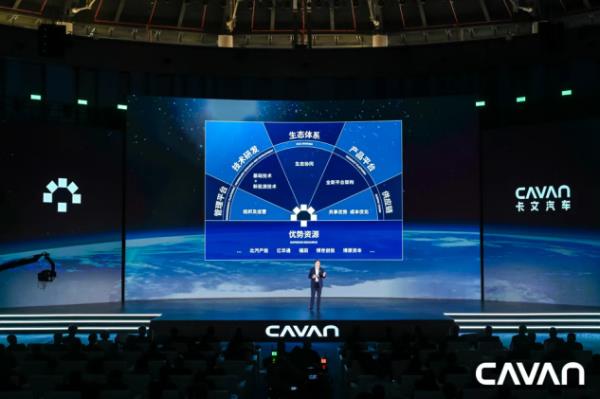
Calvin Automobile brand will focus on the bright future of new energy technology leadership, user value creation and sustainable development, take "making every kilometer better" as its brand mission, and devote itself to delivering intelligent vehicle services that exceed customers’ expectations, achieving the leading position in platform technology and new energy technology, developing a new eco-business model with high intelligence and building a sustainable green energy business system.

The brand logo of Calvin Automobile was also officially unveiled at the meeting. Among them, the Chinese word "Ka" is fully integrated with the image of leaves, which means that Kawen absorbs natural energy and empowers the industry to develop sustainably with low carbon through the transformation of new energy technology and scientific and technological ecology. English logo "CAVAN", the initial letter C stands for Carbon, which reflects the firm commitment to the development of low-carbon era; The suffix n stands for New Energy and Nature, which promotes the harmonious coexistence of green transportation and nature with new energy technology innovation; AVA is the symbol of Calvin’s "3A" spirit-Advanced new energy technology, Advanced design concept and Advanced quality.

At the same time, Calvin Automobile will build a sustainable zero-carbon ecosystem in the whole value chain with all walks of life through the creation of zero-carbon supply chain, zero-carbon factory and zero-carbon products from the three dimensions of "car-chain-circle". Qin Zhidong, general manager of Calvin Automobile, said that the company promised to achieve carbon neutrality in the whole value chain by 2040.

Brand-new products exceed expectations to meet demand

At present, Calvin Automobile has built the Master architecture technology through independent innovation, focusing on breakthroughs and innovations in core technologies such as vehicle platform architecture, electronic and electrical architecture, fuel cells, hydrogen storage systems, and Sanpower. The company also pioneered a cross-platform, extensible and highly heterogeneous centralized electronic and electrical architecture for commercial vehicles, developed an industry-leading high-power hydrogen fuel cell engine and a liquid hydrogen storage system focusing on trunk transportation, and independently developed cutting-edge new energy and intelligent technologies such as high-performance electric drive bridges.

At the product level, Kavan focuses on two technical routes, pure electric and hydrogen fuel cells. All products are developed in the forward direction, focusing on three platforms, namely VAN, light truck and heavy truck, to create products that meet the needs of urban logistics, medium and long-distance trunk logistics and other scenes, and meet the needs of users with the characteristics of light weight, low energy consumption, long battery life, intelligence and high comfort.

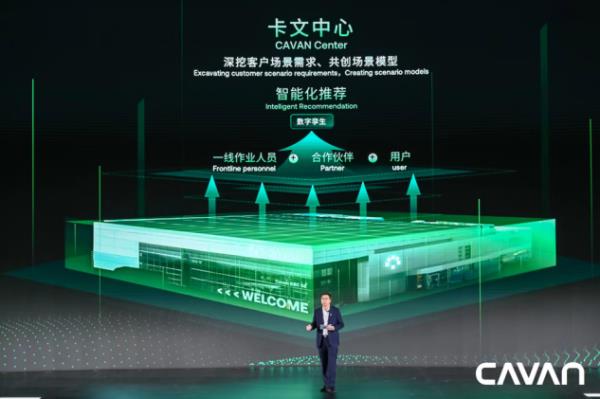
In addition, Calvin Automobile will optimize the supply chain construction, create a green supply chain, and actively explore the continuous innovation of business ecology to provide users with new energy solutions integrating vehicle, intelligent transportation capacity, charging facilities and energy management.

Qin Zhidong introduced that in the next three years, Calvin Automobile will launch three platform products in domestic and foreign markets, and this year will be the first to launch a highly intelligent pure electric VAN product.

Focus! Interpretation of the optimization and adjustment of Beijing passenger car lottery policy

  Xinhua News Agency, Beijing, June 1st Question: Focus! Interpretation of the optimization and adjustment of Beijing passenger car lottery policy

  Xinhua News Agency "Xinhua Viewpoint" reporters Lu Chang, Ding Jing and Xia Zilin

  On June 1st, Beijing issued the Interim Provisions on the Regulation of the Number of Small Passenger Cars in Beijing (revised draft for comments), the detailed rules for the implementation of the Interim Provisions on the Regulation of the Number of Small Passenger Cars in Beijing (revised draft for comments) and the index allocation scheme for the one-time issuance of new energy passenger cars (revised draft for comments). According to the above regulations and plans, the current regulation and control policies for passenger cars in Beijing will be greatly optimized and adjusted.

  What benefits will the adjustment bring? What impact will it have? The "Xinhua Viewpoint" reporter combed.

  Aspect 1: Give priority to "car-free families"

  According to the lottery results of the latest passenger car index in Beijing in April this year, the winning ratio is about 2898:1, and the difficulty has reached a record high. In addition, this year’s 54,200 personal new energy indicators have also been exhausted in the first phase, and new applicants will wait for a long time. "I can’t shake it for a long time" brings inconvenience to many "car-free families".

  According to the new regulation policy of passenger cars, on the basis of participating in the allocation of ordinary indicators and new energy indicators on an individual basis, Beijing has added the allocation of indicators with "car-free families" as the unit and sorting points. At present, applicants who are participating in the allocation of indicators in their own names can form a family or multiple families to apply for indicators with their spouses, children and parents who meet the requirements if they want to switch to applying for indicators on a family basis. Among them, non-Beijing family members are required to hold Beijing residence permit and pay social insurance and personal income tax in Beijing for nearly five years.

  The reporter learned that a "car-free family" needs at least two people, and all members can’t have a passenger car registered in Beijing. Rong Jun, deputy director of the Beijing Municipal Transportation Commission, said that with the deepening of data integration and sharing between the state and different departments such as population, marriage registration and vehicle management in Beijing, the allocation of indicators by family has a technical and data foundation. This policy optimization plan will require family applicants to jointly make a commitment to the authenticity, accuracy and completeness of the information provided, and incorporate the performance of the commitment into the applicant’s personal credit record.

  Aspect 2: The lottery integral rules and quota ratio are all inclined to "car-free families"

  According to the proposed method, the "car-free family" lottery will calculate the total family points according to the points of each family applicant. Family applicant points are composed of basic points and ladder (waiting) points. Among them, the basic score of the main family applicant is 2 points, and the basic score of other family applicants is 1 point per person. According to the new policy, the allocation of indicators gives "car-free families" significantly higher than the winning rate of individual ordinary indicators and the quota number of new energy indicators.

  Take a family of three as an example. The family applicant consists of the principal applicant, the principal applicant’s spouse and a child, with three people in two generations. For example, both husband and wife are lottery (at present, the average step score of individual lottery is 5 points). According to the integral formula, the family score is 54 points, which is 54 times that of the individual who participated in the lottery for the first time and more than 10 times that of the principal applicant.

  According to the new policy, when applying as a family, the more family applicants, the higher the total score of the family and the higher the probability of obtaining the index. In the allocation of new energy indicators, in addition to the quota allocated to units and operating vehicles, 80% of the indicators are first allocated to "car-free families" according to the level of family scores.

  Aspect 3: This year, 20,000 new energy indicators will be issued to "car-free families" at one time.

  According to the proposed measures, Beijing will issue 20,000 new energy minibus indicators at one time, all of which will be allocated to "car-free families". The allocation of one-time additional issuance indicators is planned to be implemented in August this year, and the specific allocation method is consistent with the scheme of allocating new energy passenger cars by family points.

  The relevant measures are clear, and the relevant information of all applicants will be preliminarily reviewed by the relevant departments through data exchange and comparison. The families that pass the preliminary examination are sorted from high to low according to the total score of the family. When the total score is the same, the order of the registration time of the family applicants in the minibus management information system is adjusted as early as possible. The ranking results are publicized on the designated website. The top 20,000 families will be rechecked by the relevant departments, and if they pass the verification, a notice of confirmation of indicators will be issued.

  Cheng Shidong, director of the Urban Transportation Research Center of the Comprehensive Transportation Research Institute of the National Development and Reform Commission, believes that issuing 20,000 new energy indicators to "car-free families" can effectively solve the demand for some family cars, effectively enhance the sense of acquisition, and further stimulate automobile consumption.

  Aspect 4: "One person with more cars" is gradually banned.

  According to the proposed measures, Beijing plans to increase the restrictions on the number of individuals applying for updating indicators. If a person owns more than one passenger car registered in Beijing, he can choose one of them to apply for updating the index when updating the vehicle, and the other vehicles will not be updated, but he is allowed to transfer the redundant vehicles to the spouse, children and parents of the passenger car whose name is not registered in Beijing. The transferee does not need the index certificate but must meet the condition of "individual with domicile in Beijing". In addition, the kinship between the transferee and the vehicle registration owner must last for one year. For the registration of vehicle change between husband and wife and the registration of vehicle transfer for divorce analysis, it is also necessary to meet the condition that the marriage has expired for one year.

  Rong Jun said that the passenger car index is a limited social public resource, and this policy optimization plan proposes that individuals with multiple cars can only apply for an updated index, mainly to further enhance the fairness of the distribution of social public resources. "As a personal property, the vehicle owner can use it until it is scrapped. When it needs to be updated, you can choose one of them to apply for updating indicators."

  It is understood that the index regulation and management department will strengthen the crackdown with the public security, traffic control and judicial departments on the illegal rental and sale of multiple vehicles under one person’s name and the paid transfer of indicators through marriage registration. Once verified, the indicators will be recovered, and those who have purchased vehicles will be blacklisted and will not be updated.

  Aspect 5: The number of annual quota quotas will not be adjusted for the time being.

  The reporter learned that the policy optimization plan is mainly to adjust the allocation method. In principle, the number of annual quota quotas for next year will not be adjusted for the time being. The Beijing Municipal Commission of Communications and other relevant departments said that they will combine the Beijing urban master plan with the "in accordance with ‘ Controlling possession, restricting use and differentiating ’ The principle of the implementation of traffic demand management, by 2035, the proportion of passenger cars and the average travel intensity decreased by not less than 30%.

  Statistics show that at present, the number of registered passenger cars in Beijing is 5.26 million. Cheng Shidong said that in the long run, Beijing still needs to guide the rational use of cars by parking to achieve the goal of "static braking", and should speed up the improvement of public transportation and green travel environment to enhance its attractiveness and competitiveness.

  Rong Jun introduced that in 2019, the proportion of green travel in Beijing reached 74%, and it is expected to increase by another percentage point this year. "It is necessary to improve and optimize the industrial layout and residential layout, and alleviate the traffic congestion problem by promoting the balance between occupation and residence."

  It is reported that relevant units and people from all walks of life can put forward opinions or suggestions on the Interim Provisions on the Regulation and Control of the Number of Passenger Cars in Beijing (Revised Draft for Comment) and the Detailed Rules for the Implementation of the Interim Provisions on the Regulation and Control of the Number of Passenger Cars in Beijing (Revised Draft for Comment) by e-mail and letter before June 30, 2020, and the optimized regulation and control policies will be implemented next year.

Northeast China and North China continue to "steam sauna", and the high temperature in the south will be intermittent today and tomorrow.

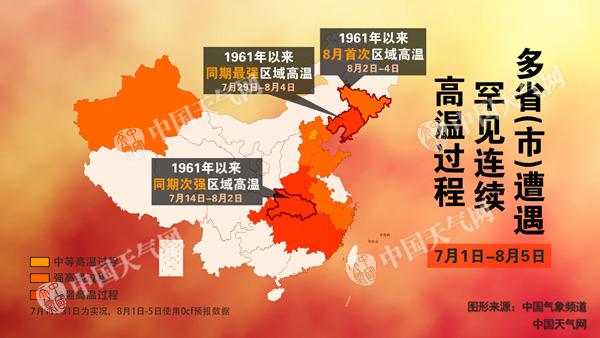
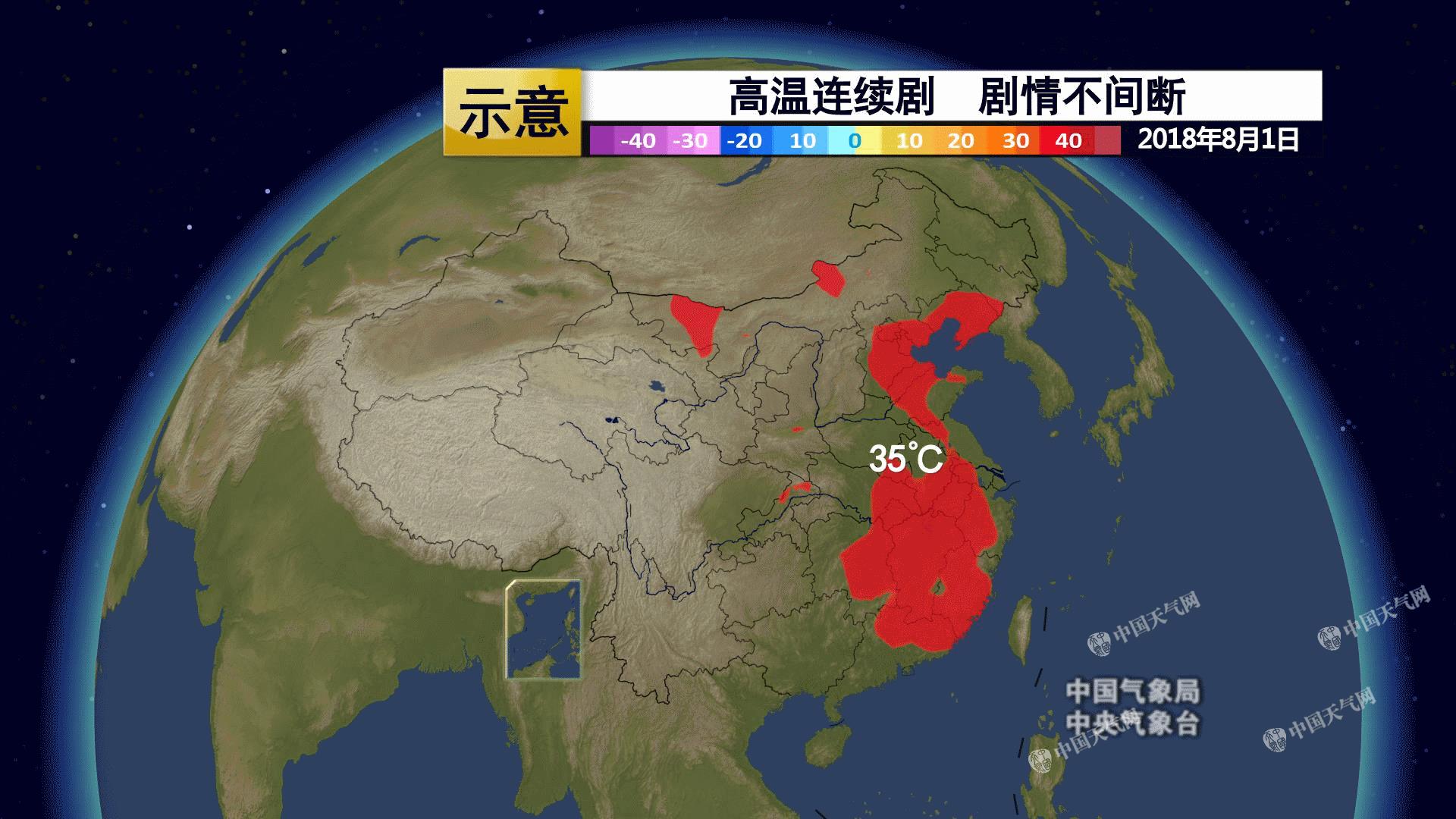
  CCTV News:According to China Weather Network, recently, due to the influence of subtropical high, there has been a continuous sultry sauna day in the northeast and north China, and the highest temperature in many places has broken historical extremes. It is expected that this round of high temperature weather in the north will gradually weaken and fade on the 5 th. The high temperature has gone up and down. Affected by the rain and the wind and rain brought by the lark, the high temperature range in the south will be significantly reduced today (2 nd) and tomorrow, and it will make a comeback on the 4 th.

  The high temperature has gradually weakened since the "sauna" in Northeast China and North China continued for 5 days.

20180801150415375_ High Temperature _ Copy. jpg

  Since the end of July, due to the influence of subtropical high, there has been continuous high temperature weather in northeast and north China, and the air humidity is high, making people feel like a sauna. Yesterday, there was a high temperature in Shenyang, Liaoning Province for the fifth consecutive day. The highest temperatures in Dandong and Dalian reached 37.3℃ and 36.9℃ respectively, setting a meteorological record for extreme values. Temperatures in Beijing, Tianjin and Hebei and Shandong are also above 35℃, which is sultry and unbearable.

High temperature 4_ copy. jpg

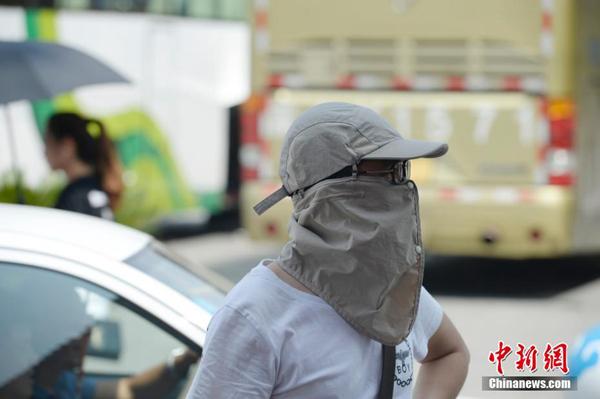
  Yesterday, street people in Hohhot wore sunscreen masks to travel. Recently, the meteorological department of Inner Mongolia has continuously issued high-temperature warnings.

  In the next few days, the above areas will still accept high temperature "baking inspection". The Central Meteorological Observatory predicts that before August 5, the high temperature in Beijing-Tianjin-Hebei, northern Shandong, central and eastern Inner Mongolia, most of Liaoning and central and southern Jilin will gradually develop, and the high temperature in Beijing-Tianjin-Hebei and Liaoning will last for 3 to 5 days. In this regard, the Central Meteorological Observatory continued to issue a high-temperature yellow warning this morning.

  In this round of high temperature process, Shenyang is "outstanding". The highest temperature in Shenyang has exceeded 35℃ for five consecutive days, and the highest temperature will continue at or above 35℃ in the next three days, which is likely to break the record of the highest number of consecutive days of high temperature, which appeared in 1952 and lasted for five consecutive days. At the same time, the highest temperature in Shenyang today may reach 37℃, which will set a new record for the local extreme highest temperature in August (the previous record was 35.7℃). In addition, with the continuous expansion of high temperature, the temperature in Changchun may reach 36℃ on the 3rd, which will not only set a new high this year, but also become the hottest day in the local observation history in August. The high temperature in Changchun in August is very rare, and there has been only one high temperature on August 3, 1968 since it was recorded in 1951.

  In addition to the northeast, Beijing-Tianjin-Hebei and northern Shandong will also have high temperatures in the next three days, and the highest temperatures in Beijing, Tianjin, Shijiazhuang and Jinan will remain at 35 C or above. The temperature in North China is high during the day and not low at night, and the lowest temperature is mostly above 26℃, and Tianjin will exceed 28℃. Moreover, due to the high relative humidity, the somatosensory temperature is higher, and the sultry feeling is not inferior to that in the south.

  The Central Meteorological Observatory predicts that in five days, the hot weather in the above-mentioned areas in the north will end. This round of high-temperature weather lasts for a long time, and the high temperature in some areas breaks the extreme value. People in the above areas need to be prepared for heatstroke prevention and cooling, and try to avoid going out at the hottest noon. If they have to go out, they should take sun protection measures and replenish water in time. Outdoor workers prepare some heatstroke prevention drugs for emergencies.

  The high temperature area in the south has been significantly reduced, and it has made a comeback since the 4 th

http://www.gzwmhq.cn/wp-content/uploads/2024/01/YW9ed46W.jpg

  For many places in the south that have been suffering from high temperature for nearly half a month, we will enjoy a short coolness today and tomorrow. Affected by the rain and the wind and rain brought by the typhoon "Lark", the high temperature area in the south will continue to shrink today and tomorrow. Today, the western and southern parts of the south of the Yangtze River and most of southern China are out of the high temperature range. Tomorrow, there will be little high temperature left, only parts of northern Chongqing, northeastern Hubei and northwestern Jiangxi still have a small range of high temperature, and the rest areas will basically end the high temperature temporarily. In the area of Jiangsu, Zhejiang and Shanghai, due to the wind and rain brought by the typhoon "Lark", the maximum temperature in many places will drop to around 30℃ tomorrow.

  Although the high temperature in the south has shrunk, the highest temperature in many places is still around 33℃, and the sultry feeling will continue. At the same time, the cooling time is very short. Starting from the 4th, the high temperature in the south will return strongly. At present, it is in the middle of the sky, and high temperature is the main theme. People in the southern region need to continue to prepare for heatstroke prevention and cooling.